The 2026 Tamil Nadu Assembly Election — What the Numbers Actually Tell Us
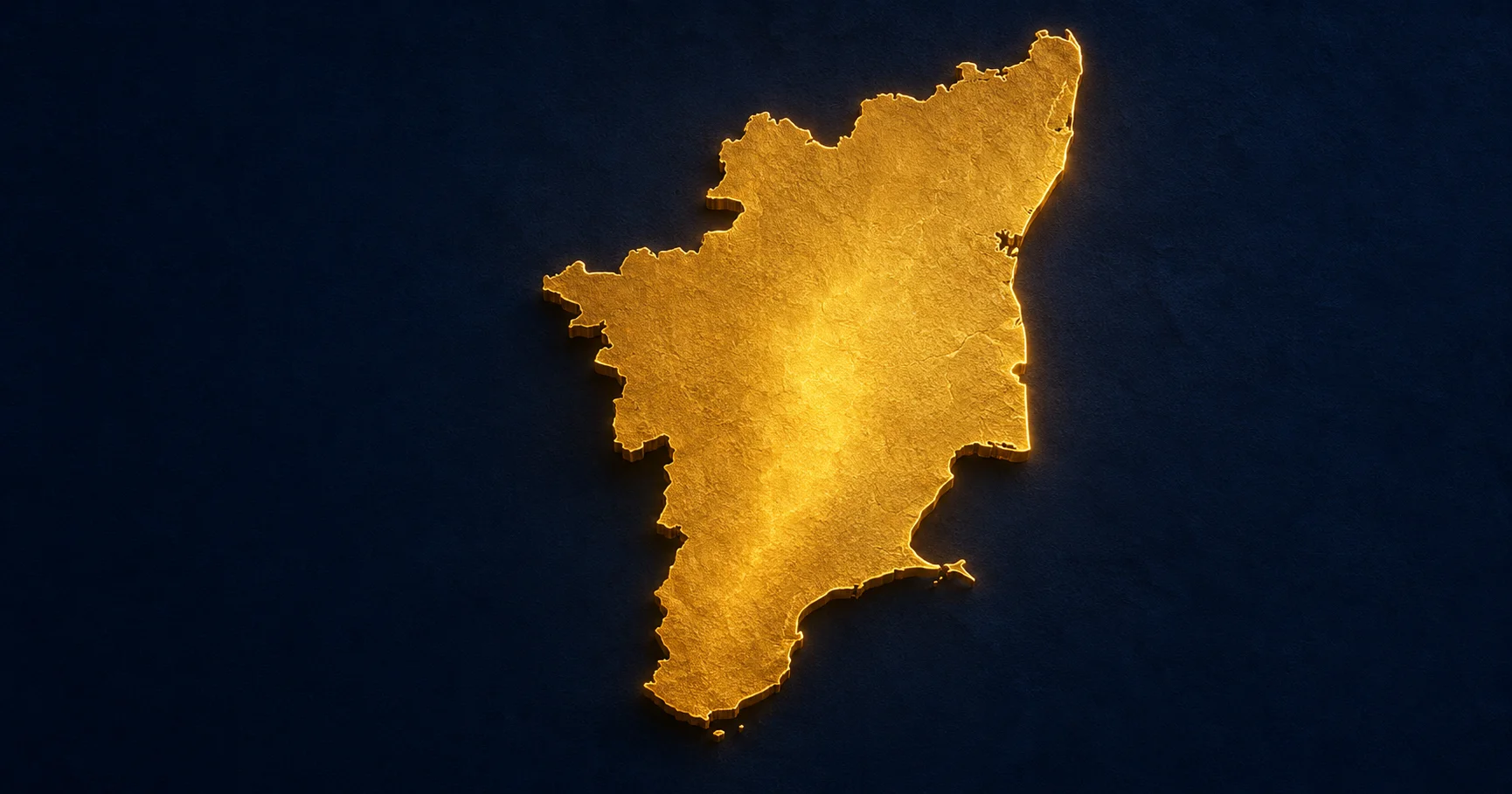
Tamil Nadu has seen political earthquakes before. MGR broke from the DMK in 1972 and built a movement. Jayalalithaa fell and rose and fell again. But what happened on 4 May 2026 was something different — something that the numbers tell with striking clarity, if you know how to read them.
A two-year-old party, led by a film actor with no prior political experience, not only entered the Tamil Nadu Assembly but emerged as the single largest party — winning 108 of 234 seats and breaking a 59-year Dravidian duopoly that had seemed unshakeable. Vijay’s Tamilaga Vettri Kazhagam didn’t just win. It rewrote the rules.
This is my attempt to read those numbers — carefully, honestly, and without partisan lens.
THE HEADLINE NUMBERS
Let’s start with what the scoreboard says:
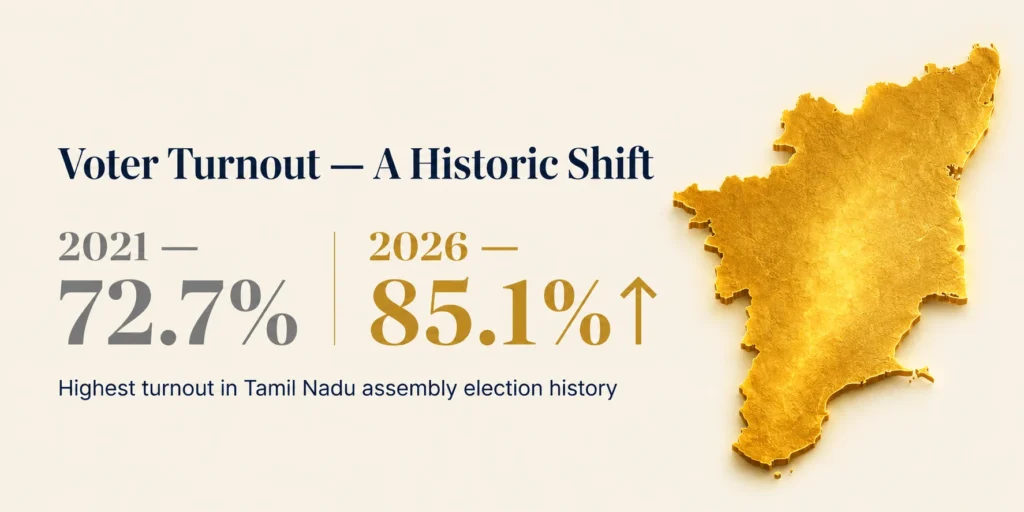
The election was held on 23 April 2026, with results declared on 4 May. Voter turnout was a remarkable 85.1% — the highest in Tamil Nadu’s history, up significantly from 72.7% in 2021. That number alone tells us something important: this election generated extraordinary public engagement. People who had never voted, or hadn’t voted in years, came out. And they came out for a reason.
TVK contested 233 of 234 constituencies — alone, with no alliance. It won 108. The DMK-led Secular Progressive Alliance, which had swept all 39 Lok Sabha seats just two years earlier in 2024, was routed. Chief Minister M.K. Stalin lost his own Kolathur constituency — a seat he had won three consecutive times. Fifteen ministers from his cabinet were defeated.
The AIADMK, the traditional opposition, survived but did not thrive. Former Chief Minister Edappadi K. Palaniswami retained Edappadi with the widest winning margin in the state — a personal victory in a party defeat.
BJP remained marginal in Tamil Nadu’s direct electoral arithmetic, as it has consistently been.
WHAT THE NUMBERS ACTUALLY MEAN
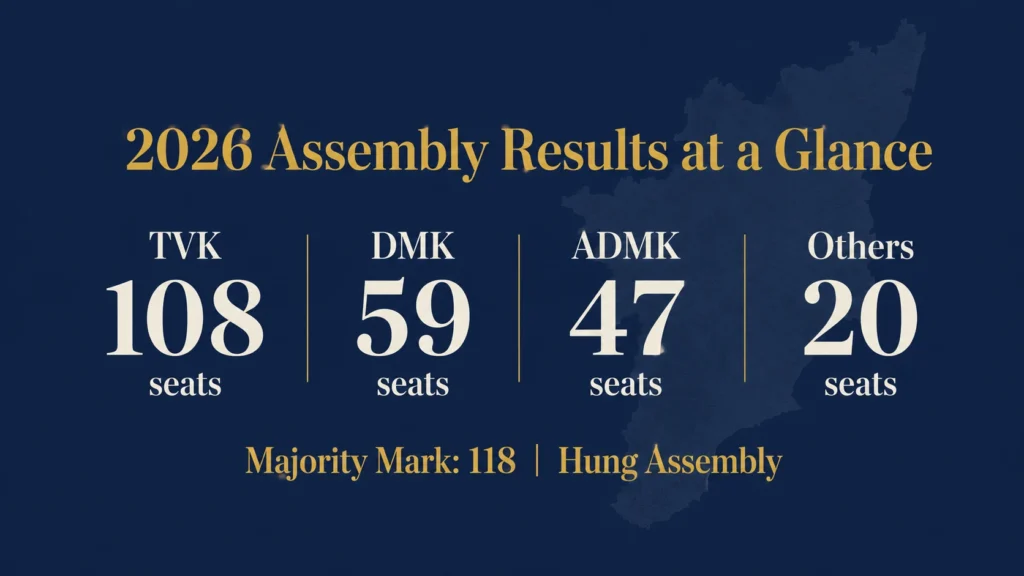
108 seats sounds like a landslide. It wasn’t — not structurally. TVK fell short of the majority mark of 118. This is a hung assembly, and the manner in which Vijay assembled his government reveals as much about Tamil Nadu’s political future as the election result itself.
TVK secured government with support from INC, VCK, and IUML — which broke from the DMK-led SPA to join Vijay — along with outside support from CPI(M), and CPI. This coalition of 120 MLAs is ideologically diverse, held together more by the momentum of a historic result than by a unified political programme.
“Notably, VCK’s and IUML’s departure from the SPA signals community-level disenchantment with the DMK that goes beyond mere electoral arithmetic — Dalit and minority voters, long considered DMK’s reliable base, appear to have partially shifted their trust.”
The first question any serious analyst must ask is: how durable is this coalition?
The second question is equally important: where did TVK’s votes actually come from?
Analysts who studied the result closely noted that TVK drew from both DMK and AIADMK vote banks simultaneously — pulling youth voters, women voters, urban voters, and first-time voters across caste and religious lines. This is extraordinary. Tamil Nadu’s political arithmetic has historically been deeply caste-structured. TVK appears to have partially disrupted that structure — or at least suspended it temporarily through the force of Vijay’s personal appeal.
Notably, VCK’s and IUML’s departure from the SPA signals something deeper — Dalit and minority voters, long considered DMK’s reliable base, appear to have partially shifted their trust. This goes beyond mere electoral arithmetic. It is a community-level statement that the DMK’s decade-long relationship with these constituencies can no longer be taken for granted.
THE STRUCTURAL SHIFT
For 59 years, Tamil Nadu politics operated on a predictable axis: DMK and AIADMK alternated power, with smaller parties playing kingmaker at the margins. Congress, BJP, PMK, VCK — all were supporting cast in a Dravidian drama.
That axis has now cracked. Not broken — cracked.
Here is why I say cracked and not broken: TVK’s victory is built significantly on Vijay’s personal brand, his fan mobilisation machinery, and a highly organised digital campaign. The BBC described it as reflecting a major shift toward digital-first political mobilisation in India. That is true. But personal brands are not permanent political structures. MGR built one. Jayalalithaa inherited and expanded it. Both took years to institutionalise.
Vijay has two years of organisational existence behind him. The real test of whether TVK represents a structural realignment — or a spectacular but temporary disruption — will come in the next Lok Sabha election, and more critically, in the 2031 Assembly election.
THREE THINGS TO WATCH
As The Maatram begins its analytical journey, here are three specific things I will be watching closely:
1. The Coalition Stress Test TVK’s government rests on a coalition assembled in days. INC’s decision to leave the SPA and support Vijay was opportunistic, not ideological. As governance pressures mount — budget decisions, welfare delivery, administrative appointments — the coalition’s fault lines will become visible. Watch INC’s behaviour in the first budget session.
2. AIADMK’s Reconstruction Palaniswami’s personal victory at Edappadi is the one bright spot for a party that has been haemorrhaging since Jayalalithaa’s death. Five AIADMK MLAs have already resigned to join TVK. The question is whether Palaniswami can hold the rump AIADMK together as a credible opposition, or whether it fragments further. An AIADMK in disarray actually weakens Tamil Nadu democracy by removing a structured opposition.
3. DMK’s Reckoning The DMK’s defeat is more than electoral — it is existential in the short term. Stalin’s personal loss in Kolathur is symbolically devastating. The party that governed Tamil Nadu for five years, that swept the 2024 Lok Sabha election comprehensively, collapsed in 2026. The internal conversation within the DMK — about leadership, about governance record, about whether the party drifted from its base — will shape Tamil Nadu politics for the next decade.
CONCLUSION
The 2026 Tamil Nadu Assembly election is not simply a story about Vijay winning. It is a story about what Tamil Nadu’s voters were rejecting — and what they are, cautiously and provisionally, reaching for.
They rejected incumbency. They rejected the assumption that Dravidian identity alone is sufficient political currency. They reached for something that felt new, clean, and energetic — even if its policy substance remains to be defined.
Whether that reach becomes a grasp — whether TVK translates electoral momentum into governance credibility — is the central question of Tamil Nadu politics for the next five years.
The Maatram will be watching. With data. With honesty. Without fear or favour.