
AIADMK: Is the Grand Old Party of Tamil Nadu Shattering in Slow Motion?
Fifty-three years is a long time in politics. Long enough to win power, lose it, rebuild, and win again. The All India Anna Dravida Munnetra Kazhagam has done all of this — surviving the death of its founder MGR, the turbulence after Jayalalithaa, an OPS-EPS civil war, and multiple electoral defeats. It has always come back.
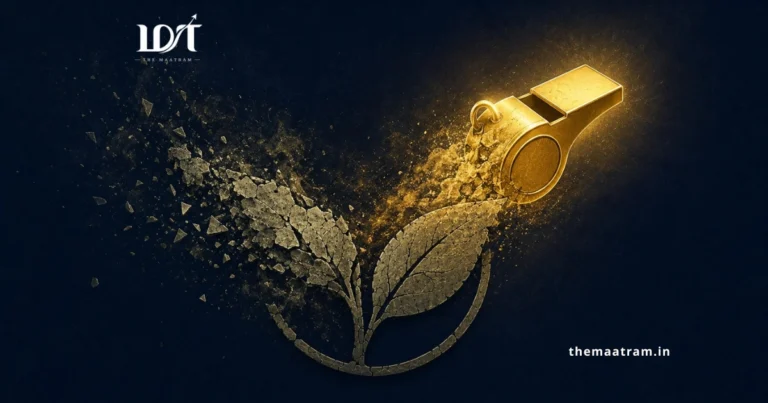
But what is happening to the AIADMK today feels fundamentally different. Not a setback. Not a temporary crisis. What Tamil Nadu is witnessing in the weeks since the May 4 election result may well be the beginning of an institutional collapse — slow, visible, and possibly potentially irreversible.
The Election That Changed Everything
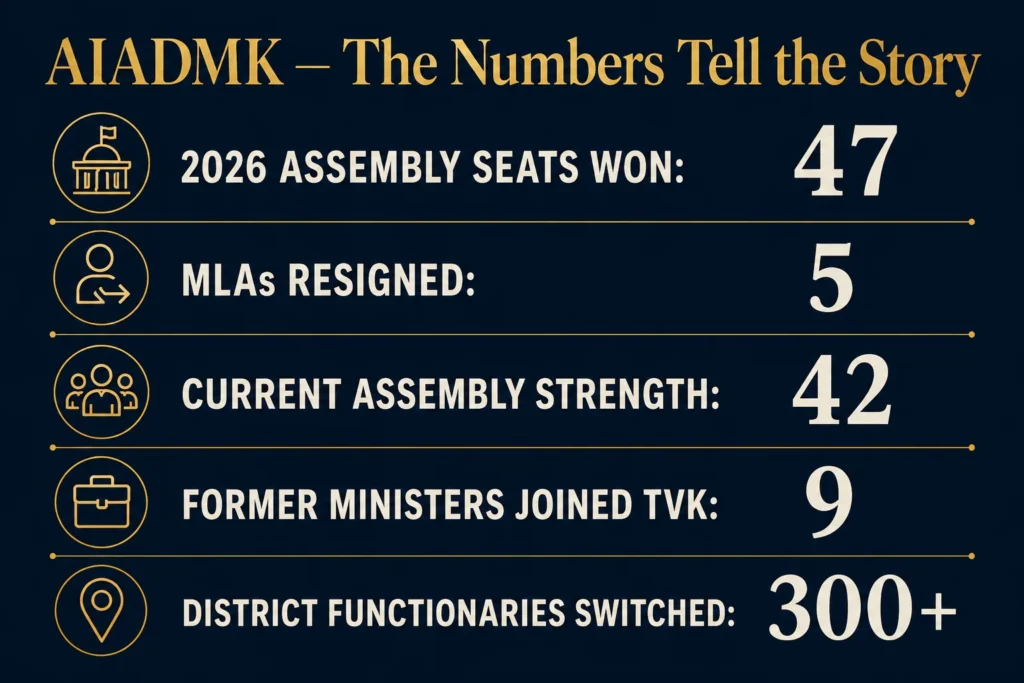
In the 2026 Assembly election, the AIADMK contested as part of an alliance with the BJP, PMK, AMMK and smaller parties, winning only 47 of the 172 seats it contested. The result cost the party its official opposition status — which went instead to the DMK, which won 59 seats.
Forty-seven seats for a party that once commanded overwhelming majorities is a story in itself. But elections can be lost and won again. The real story began only after the results were declared.
The Rebellion That Shook the Foundation
After the election defeat, a group of 25 rebel MLAs decided to reject Edappadi K. Palaniswami as their leader, splintering the party into two factions — with only 22 supporting Palaniswami as their legislative party leader.
The rebel AIADMK MLAs were moved to a Puducherry resort, with reports that a faction within the AIADMK MLAs were willing to support TVK. The resort politics — a desperate attempt to maintain physical control over legislators — exposed just how hollow the party’s command structure had become.
The rebellion eventually fizzled. The rebel MLAs submitted apology letters to EPS and returned to the fold — but only after the damage had already been done in full public view. Several rebel MLAs returned to the EPS camp to avoid disqualification under the anti-defection law, submitting apology letters to the Speaker and party general secretary for defying the party whip during the floor test.
Apology letters. From sitting MLAs. To their own party chief. This is not the image of a confident, functioning political organisation.
The Exodus Nobody Can Stop
If the rebellion was the earthquake, what followed has been the relentless aftershock. Three AIADMK MLAs — Maragatham Kumaravel from Madurantakam, S. Jayakumar from Perundurai, and P. Sathyabama from Dharapuram — resigned from the Assembly on May 25 and formally joined TVK, reducing AIADMK’s strength from 47 to 44 seats.
The defections did not stop there. The very next day, on May 26, Ambasamudram legislator Esakki Subaya — a three-time MLA and influential AIADMK strongman in southern Tamil Nadu — tendered his resignation directly to Assembly Speaker JCD Prabhakar, becoming the fourth high-profile exit within just 48 hours. Subaya had won Ambasamudram in 2026 by a margin of 10,245 votes — a comfortable personal mandate — yet saw no future in the party.
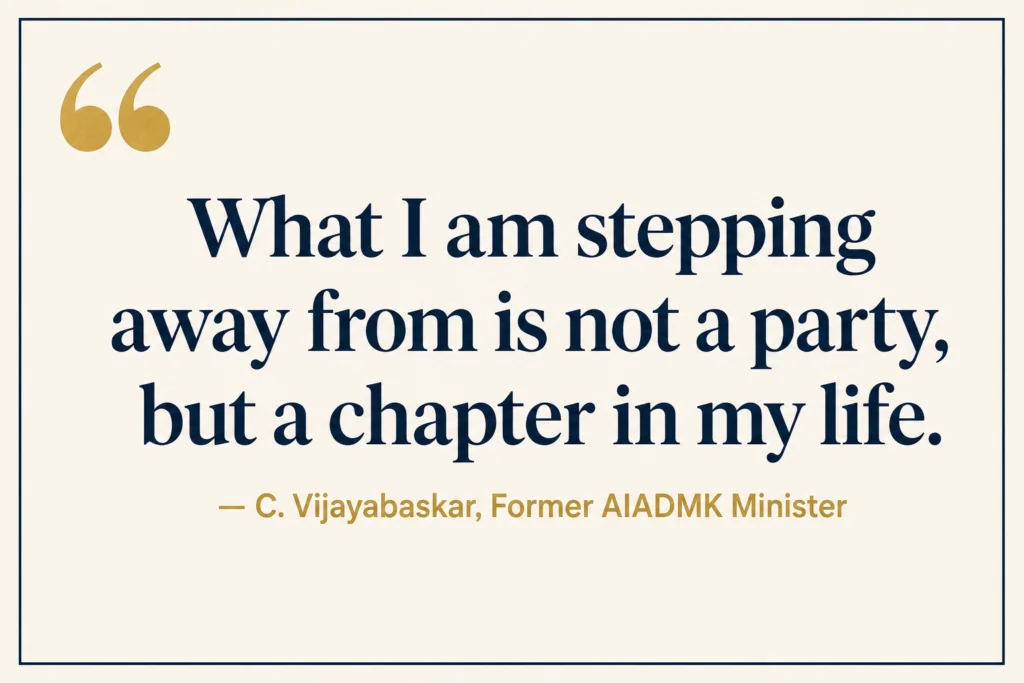
Then on June 17, the bleeding continued with yet another significant departure. Former health minister and Viralimalai MLA C. Vijayabaskar — a doctor by profession and a five-time legislator who had been with the AIADMK since his student days — submitted his resignation to Speaker Prabhakar, becoming the fifth MLA to quit in under a month. His parting words were deeply emotional: “It pains me deeply that a movement I loved all my life is now facing hardship and trials due to the wrong decisions of an individual. What I am stepping away from is not a party, but a chapter in my life.”
With Vijayabaskar’s exit, AIADMK’s assembly strength dropped to 42 MLAs — down from 47 just weeks earlier. Five sitting MLAs gone in one month. Each departure carrying its own emotional weight. Each one making the next departure easier for those still watching from inside.
The exodus of leaders continued with former minister Vellamandi N. Natarajan, Anna Thozhir Sanga Peravai State Secretary Kamalakannan, IT wing deputy secretary Karthik, former Mylapore MLA R. Natraj, and former Minister MSM Anandan all joining TVK.
Then came the June 6 wave. Four former AIADMK ministers — Udumalai K. Radhakrishnan, MC Sampath, Kadambur C. Raju, and NR Sivapathi — joined TVK at its headquarters, along with former MP A. Ilavarasan and seven former AIADMK MLAs.
Around 16 former AIADMK ministers and leaders quit the party after the EPS-Shanmugam reconciliation — and 12 of them joined the TVK. More than 300 district functionaries have also switched to TVK.
This is not a trickle. This is a flood. The pace of exits suggests something far more serious than routine post-election defections.
TVK’s Calculated Strategy
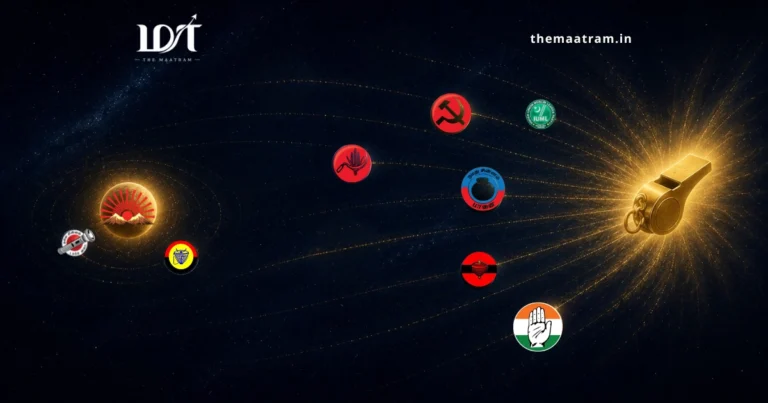
Let us call this what it is. TVK is executing a deliberate strategy of institutional absorption. TVK has appointed K.A. Sengottaiyan as chief coordinator to bring in more members from the AIADMK. As a veteran of the MGR and Jayalalithaa eras, Sengottaiyan serves as an important bridge for defectors.
TVK Minister Aadhav Arjuna has made the strategic intent explicitly public. Speaking at a TVK induction event where over 300 AIADMK members joined the party, he declared that within one month, 90 percent of AIADMK members would join TVK — arguing that it was EPS’s own decision to align with the DMK that was driving cadres away. At a separate event welcoming former AIADMK ministers, he told the gathering: “We are all one family. I can see the whole AIADMK here.”
Whether the 90 percent claim is political reality or calculated theatre, the direction of travel is unmistakable. TVK is not passively receiving defectors. It appears to be actively accelerating AIADMK’s organisational decline.
Vijay himself had set the tone long before the election. Throughout the campaign, he consistently framed the contest as being only between TVK and DMK — deliberately placing AIADMK in the bracket of “Others” without even uttering the party’s name. That rhetorical erasure has now become an organisational reality.
The DMK Merger Suggestion — And Why It Is Lethal
Into this volatile situation stepped a DMK spokesperson with a provocative idea — why not consider a merger between AIADMK and DMK? After all, the argument goes, the AIADMK was born when MGR broke away from the DMK in the 1970s. They share Dravidian roots. They speak the same political language.
It is a suggestion that sounds logical on paper. It is political poison in practice.
AIADMK’s entire identity for five decades has been built in opposition to the DMK. Its cadres do not merely dislike the DMK — for many, opposing the DMK is the reason they joined the AIADMK in the first place. Any move toward merger or even formal alliance with the DMK would trigger a mass cadre revolt that would make the current exodus look minor by comparison.
EPS understands this. Which is why any such suggestion will be firmly rejected — publicly at least. But the fact that the DMK is even floating this idea reveals something important: the DMK sees the AIADMK not as a rival to respect, but as an organisation to absorb or eliminate.
Can EPS Save the Party?
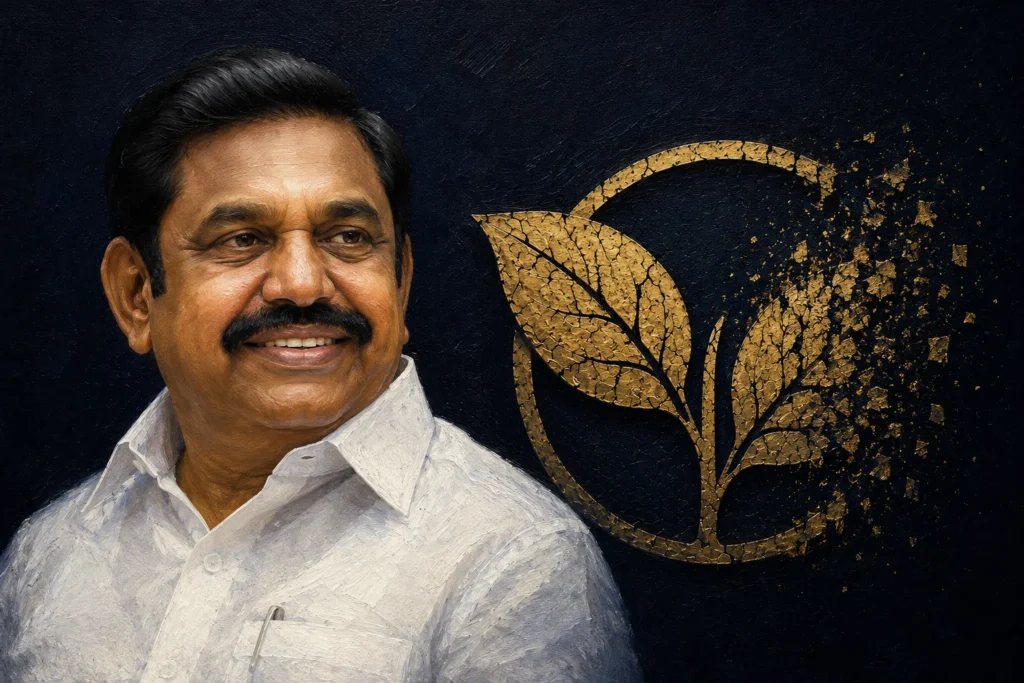
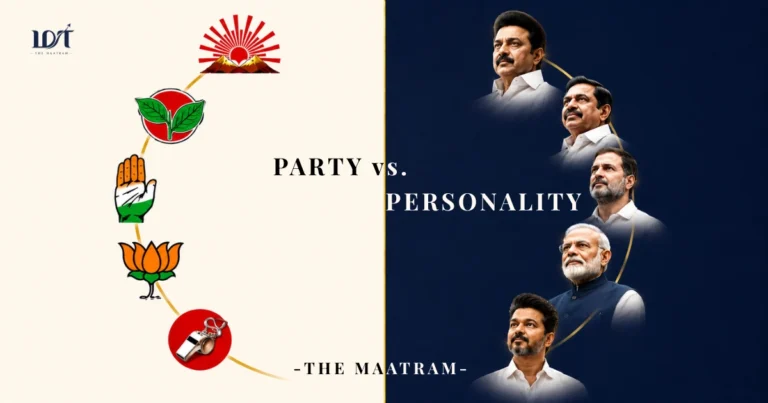
EPS eventually established himself as the dominant leader after years of internal battles. However, critics argue that he has yet to build the kind of emotional connection that Ramachandran and Jayalalithaa enjoyed with the Tamil public.
It would, however, be unfair to place the entire burden of the AIADMK’s decline on Edappadi K. Palaniswami alone. Few political leaders inherit a party under circumstances as difficult as those he faced.
The AIADMK has spent the past decade navigating the loss of two towering personalities — MGR and Jayalalithaa — internal leadership battles, repeated electoral defeats, the emergence of new political challengers, and a rapidly changing voter landscape. Any leader would have found that an extraordinary challenge. The real question is not whether EPS has worked hard enough. It is whether any leader, however capable, could have rebuilt the AIADMK into a winning force without first rediscovering the emotional connection that once defined the movement.
The AIADMK currently faces a binary choice — total institutional decay after five years in opposition, or a compromise that facilitates participation in the TVK-led government. This internal rift, following the party’s failure in its 11th consecutive election since the demise of Jayalalithaa in 2016, is likely the endgame for the AIADMK in its traditional form.
That is a damning assessment — and not an unfair one.
EPS won his own seat in Edappadi with the widest margin of the election. Personally, he remains undefeated. Institutionally, the party he leads is hemorrhaging. That gap between personal electoral strength and organisational authority is the central paradox defining AIADMK’s current crisis.
What happens Next?
The AIADMK is not dead. It still has MLAs, district structures, a recognisable symbol, and decades of voter memory to draw on. EPS remains a formidable individual political force in his own constituency and community.
But a party is more than its leader’s personal vote. It is an organisation, a network, a shared belief that belonging to this institution means something.
Right now, for thousands of AIADMK functionaries across Tamil Nadu, that belief is evaporating — one resignation letter at a time.
The question is no longer whether the AIADMK will change. It is whether what remains after the change can still be called the AIADMK.
Political parties rarely disappear overnight. More often, they weaken gradually — through every resignation, every silent cadre who stops attending meetings, every district functionary who quietly switches allegiance, and every voter who slowly stops believing that tomorrow will be better than yesterday. The greatest threat to the AIADMK may not be another electoral defeat. It may be the gradual erosion of confidence within its own organisation.
Because once a political movement loses faith in itself, rebuilding it becomes infinitely more difficult than winning an election.

One Comment