AIADMK — Part II: The Walls Are Closing In on EPS
When The Maatram published its first analysis of the AIADMK’s post-election crisis, the party had lost five MLAs and was haemorrhaging district functionaries at an alarming rate. We asked then whether what remained after the exodus could still be called the AIADMK.
Since that piece was published, the answer has become grimmer. The exits have not slowed. They have accelerated.
And on July 2, 2026, Tamil Nadu witnessed what may well be the single most consequential day for the AIADMK since Jayalalithaa’s death — a grand induction ceremony at Mamallapuram that brought two former ministers, hundreds of functionaries, and 15,000 supporters into the TVK fold in one sweeping move.
July 2 — The Mamallapuram Moment
The event was not quiet or incidental. It was theatrical, deliberate, and massive.
Former AIADMK ministers C. Vijayabaskar and M.R. Vijayabaskar formally joined the ruling TVK along with around 15,000 supporters at a grand induction ceremony held at a private hotel in Mamallapuram near Chennai. The induction was led by TVK General Secretary and Minister N. Anand, with Minister Aadhav Arjuna welcoming the new entrants with the party’s traditional shawl.
Apart from the two former ministers, former ministers S. Valarmathi and M.S.M. Anandan also joined, along with former MLAs Manraj, M. Ramkumar, Rajavarman, Sathan Prabhakar, and Thirugnanasambandam, besides district secretaries P.K. Vairamuthu, Ilambai Tamilselvan, M. Sekar, and Srinivasan. The party also announced that 208 former AIADMK union secretaries had joined TVK during the event.
The induction programme witnessed a massive turnout, with supporters arriving in nearly 200 buses and around 600 cars from Karur, Pudukkottai and several other districts.
This was not a trickle. This was an organised, choreographed departure — complete with buses, cars, and 15,000 people. Someone planned this. Someone coordinated it. And the message to those still sitting inside the AIADMK could not have been louder.
Who Left — And Why It Matters
Understanding who joined TVK on July 2 is important because these are not peripheral figures.
C. Vijayabaskar — Former Health Minister, five-term MLA from Viralimalai, one of the most prominent faces of the EPS government. He had already resigned his MLA seat on June 17. Speaking ahead of joining, he said the collective decision was not made in haste but decided after a series of consultations with his supporters, district office bearers, and the people of his Viralimalai constituency, unanimously desiring political change. He attributed his departure to the “wrong decisions” made by the present AIADMK leadership.
M.R. Vijayabaskar — Former Transport Minister appointed by Jayalalithaa herself in 2016, representing Karur. A different person from C. Vijayabaskar but equally senior — a Jayalalithaa-era minister walking away speaks volumes about how deep the disillusionment runs.
S. Valarmathi — Former Minister for Backward Classes, Most Backward Classes and Denotified Communities under Jayalalithaa and EPS governments. MLA from the historic Srirangam constituency, she won her seat in a 2015 by-election from the constituency previously held by Jayalalithaa herself. Her departure carries significant symbolic weight — a woman minister who held a seat once occupied by Amma, now choosing TVK.
MSM Anandan — Former Minister who had already been informally associated with the TVK orbit. His formal joining at Mamallapuram now makes it official.
Addressing the gathering, former AIADMK stalwart and now TVK minister Sengottaiyan said: “When I was thrown out of my party, our leader made me a minister now. You all felt bad when AIADMK tried to make an alliance with DMK, the enemy of AIADMK. There is no betrayal here but it’s there — in AIADMK. You have all come where great leadership exists. Our leader is a permanent CM.”
Those words — spoken at a public event, on record, by a sitting minister — are a direct recruitment pitch to every AIADMK cadre still watching from the sidelines.
The DMK’s “Washing Machine” Jab
The political reaction came quickly. DMK MP Kanimozhi took a swipe at the latest political developments, describing them as an example of a “washing machine” model of politics.
It is a clever line. But it carries some irony coming from a party that spent years absorbing leaders from rival formations. More importantly, it misses the strategic point. TVK is not simply washing old politicians clean for optics. It is systematically dismantling the AIADMK’s organisational infrastructure — district secretaries, union secretaries, MLA networks — and transplanting them into its own structure. That is not image management. That is institution building.
The Exits Don’t Stop — July 3
The Mamallapuram event had barely concluded when the next departure arrived. On July 3, former School Education Minister Vaigai Selvan sent his resignation letter directly to EPS — becoming the latest in what is now a relentless daily drumbeat of exits.
Vaigai Selvan had served as School Education Minister under Jayalalithaa and represented the Aruppukottai constituency. His resignation arrived less than 24 hours after 15,000 people had publicly walked out at Mamallapuram. The message was unmistakable — the grand ceremony had not stemmed the tide. If anything, it had accelerated it.
Every public departure makes the next one easier. Every resignation letter that reaches EPS’s desk is both a loss and a signal to those still watching from inside.
The Rebellion Within — SP Velumani and the 9 MLAs
While the exits continue from outside, a parallel crisis is brewing inside the party.
A fresh round of internal dissent has surfaced in the AIADMK, with nine senior functionaries including eight MLAs led by former Ministers SP Velumani and Natham R. Viswanathan, declining to accept the organisational posts recently assigned to them by EPS.
In a letter addressed to Palaniswami, the leaders said they were unable to accept the responsibilities entrusted to them, citing differences over the party’s post-election political course and the alleged non-implementation of assurances made during reconciliation talks.
The dissatisfaction intensified after former Ministers C. Vijayabaskar and MR Vijayabaskar resigned as MLAs, quit the AIADMK, and announced their decision to join the TVK.
The core grievance is revealing. The signatories pointed out that the AIADMK had suffered electoral defeats in every election held since Palaniswami assumed office as general secretary. That is a direct indictment of EPS’s leadership — not from opposition members, but from sitting MLAs within his own party.
On June 25, Palaniswami announced a fresh round of organisational appointments, naming SP Velumani and Natham R. Viswanathan as deputy general secretaries. The rebels rejected even this — saying their original positions were not restored and that the assurances made during reconciliation were not honoured.
This is the AIADMK’s central paradox right now. EPS is trying to hold the party together with promotions and appointments. But the rebels do not want new titles. They want accountability for why the party has lost every election since 2016.
The Updated Scoreboard
Since the April 23 election result, the AIADMK’s position has deteriorated significantly:
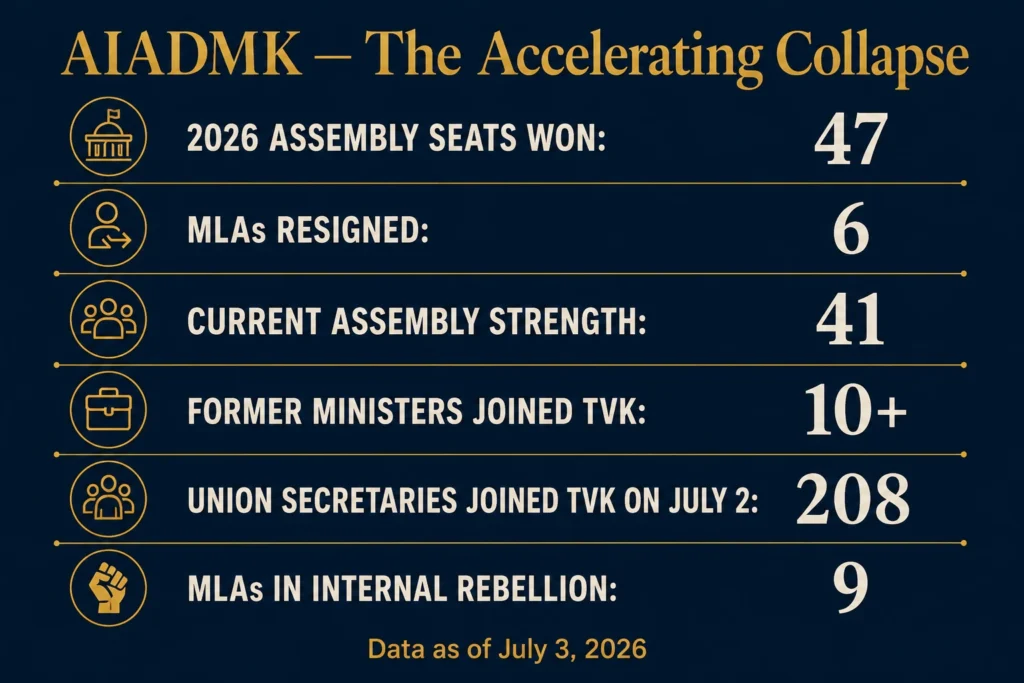
- Assembly seats won: 47
- MLAs resigned: 6 (Maragatham Kumaravel, S. Jayakumar, P. Sathyabama, Esakki Subaya, C. Vijayabaskar, MR Vijayabaskar)
- Current assembly strength: 41
- Former ministers who have now formally joined TVK: 10+ (including both Vijayabaskars, Vaigai Selvan, Valarmathi, Anandan, Sengottaiyan, Ku. Pa. Krishnan and others)
- 208 union secretaries joined TVK on July 2 alone
- 9 sitting MLAs in internal rebellion refusing EPS appointments
The Verdict
The Maatram’s first AIADMK article asked whether the party was shattering in slow motion. This article has a clearer answer.
It is not slow motion anymore.
The Mamallapuram event on July 2 was the most organised, large-scale departure the AIADMK has faced since its founding. When 15,000 people travel in 200 buses and 600 cars to publicly join a rival party, it is not a political defection. It is a political statement — about the AIADMK’s future, about EPS’s authority, and about where Tamil Nadu’s political gravity is pulling.
EPS remains undefeated in his own constituency. He remains the largest individual vote-getter in the 2026 election. He has managed to keep the formal party structure intact through a combination of reconciliation and reward.
But a party is not just its general secretary’s personal electoral strength. It is its MLAs, its ministers, its district secretaries, its union networks, and its cadres’ belief that belonging here means something.
One by one, those pillars are choosing a different address.
The question is no longer whether AIADMK can stop the bleeding. It is whether there is enough left to stop.