
A Clean & Sustainable Tamil Nadu — Comprehensive Summary of the WTL Policy Paper
Prepared by We the Leaders Foundation | Chief Servant: K. Annamalai | August 2026
Editor’s Note:
The Policy Paper for a Clean & Sustainable Tamil Nadu, released by the We the Leaders Foundation, is a comprehensive 255-page document presenting extensive research, expert inputs, case studies, and policy recommendations across multiple environmental sectors. Recognising that many readers may not have the time to go through the complete report, Maatram presents this carefully prepared executive summary. It retains the core findings, key data points, major recommendations, and overall vision of the original document while presenting them in a concise and reader-friendly format.
Overview
The Policy Paper for a Clean & Sustainable Tamil Nadu, released by the We the Leaders Foundation under the leadership of K. Annamalai, is a 255-page evidence-based policy document addressing Tamil Nadu’s most pressing environmental challenges. Covering climate change, water resources, marine ecosystems, air quality, soil degradation, deforestation, and solid waste management, the paper combines scientific research, expert consultations, and successful case studies from India and around the world to propose practical, long-term solutions.
Unlike many public policy documents that focus on political criticism, this paper deliberately avoids assigning blame to any government or political party. Instead, it concentrates on evidence-based analysis, community participation, and practical solutions that can contribute to a cleaner and more sustainable Tamil Nadu.
The document concludes with a practical action plan for August 2026 and presents a long-term vision for transforming Tamil Nadu into a model of sustainable development rooted in both scientific evidence and the state’s rich ecological traditions.
Chapter 1: Climate Change — The Global Emergency at Tamil Nadu’s Door
The paper opens with a stark global picture. Earth warmed by approximately 0.35°C between 2015 and 2025 — nearly double the warming rate of the previous four decades. In 2025 alone, 43.2 billion tonnes of carbon dioxide were released into the atmosphere. Global mean sea level has risen 23 centimetres since 1901, and is currently rising at 3.84 mm per year. The remaining carbon budget to limit warming to 1.5°C has shrunk from 500 billion tonnes in 2020 to just 130 billion tonnes at the start of 2026.
For Tamil Nadu specifically, the implications are severe. The state has 1,076 kilometres of coastline, with approximately 40% of coastal areas classified as highly vulnerable to sea level rise and erosion. Shifting monsoon patterns threaten agricultural productivity. Groundwater extraction has reached critical levels in over 60% of the state’s blocks. The quantifiable annual economic loss from climate-induced crop damage and infrastructure repair runs into thousands of crores.
Urban Heat Island data is particularly alarming. Chennai’s built-up surface area expanded from 36% of the city in 2014 to 67% in 2024, while vegetation cover collapsed from 25% to just 10%. Specific areas in Chennai — Kodungaiyur, Manali, Pattravakkam — now record Land Surface Temperatures between 35.6°C and 37.6°C. In Coimbatore, certain wards saw temperature rises of 4.1°C between 2016 and 2024. Tiruchirapalli’s New Bus Stand and Srirangam temple areas record LST between 46°C and 50°C. India has committed to reducing emissions intensity of GDP by 47% by 2035 from 2005 levels and achieving 60% non-fossil fuel electricity capacity. India has already achieved 52.57% non-fossil capacity as of February 2026 — five years ahead of schedule — a significant achievement the paper acknowledges.
Chapter 2: Water Resources — A Crisis in Three Dimensions
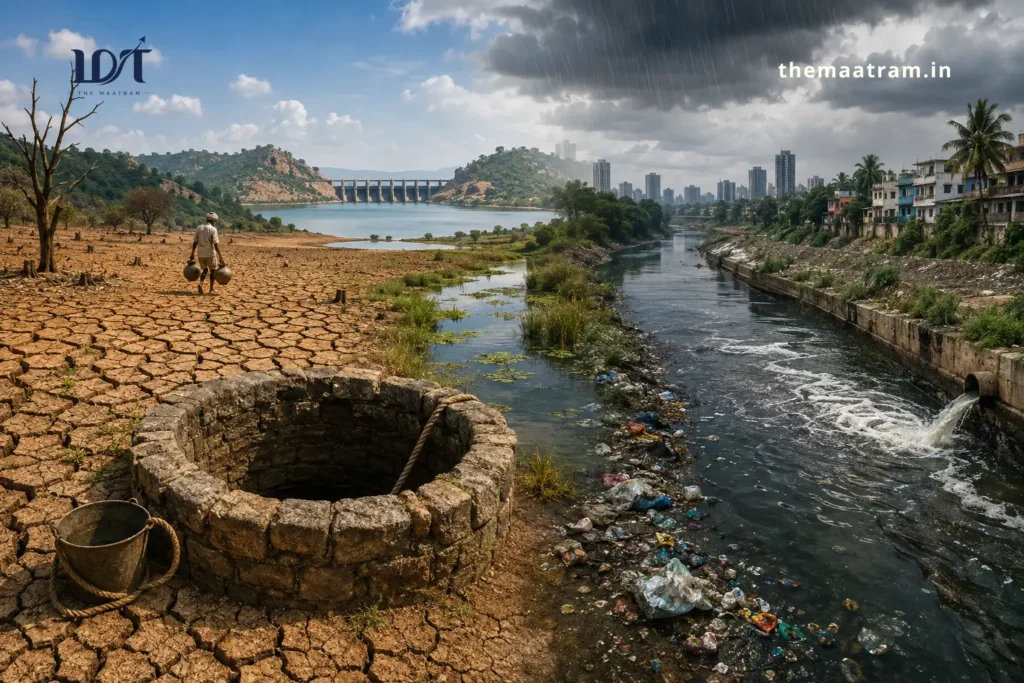
The water crisis section is the most data-dense in the document, covering groundwater depletion, rainfall patterns, river quality, lake health, and canal contamination across all 38 Tamil Nadu districts.
Groundwater Depletion is severe and district-specific. Thiruvallur saw groundwater fall by 1.14 metres between June 2025 and June 2026 — compared to a 0.01 metre rise in 2010. Multiple districts including Chennai, Kancheepuram, Chengalpattu, and Villupuram show consistent depletion in both periods. Nationally, over 60% of India’s groundwater sources are projected to reach critical degradation within 20 years. Agriculture accounts for 90% of India’s annual groundwater usage.
The paper provides a 33-year trend analysis (1990-2023) of Tamil Nadu’s rainfall patterns using Mann-Kendall and Theil-Sen statistical models. While overall rainfall trends are positive, the Northeast monsoon — which delivers approximately 50% of Tamil Nadu’s annual rainfall — shows a concerning negative trend. The correlation between seasonal rainfall and rain-fed crop production is extremely high, with R² values ranging from 0.79 to 0.98.
River quality comparisons between Tamil Nadu and Gujarat are illuminating. Tamil Nadu’s major rivers — the Cauvery, Vaigai, Palar, Adyar, and Cooum — show concerning levels of Biochemical Oxygen Demand, Total Dissolved Solids, and coliform bacteria. The Cooum river in Chennai, which flows through the city’s heart, shows extremely degraded water quality. The paper contrasts this with Gujarat’s Sabarmati — a river that underwent systematic restoration — as a benchmark for what is achievable.
The paper makes an urgent case for restoring Tamil Nadu’s traditional water infrastructure — the tank systems, canals, and local water bodies that sustained agriculture for millennia.
A case study on Telangana’s Mission Kakatiya — which restored over 20,000 tanks — and Shenzhen’s Maozhou River restoration in China are presented as international and domestic benchmarks.
Marine Ecosystems receive dedicated attention. Tamil Nadu’s coastline hosts critical wetlands — Pulicat Lake (second-largest brackish water lake in India), Pichavaram (world’s second-largest mangrove forest in India), Muthupet mangroves, and the Gulf of Mannar Marine National Park — India’s first marine biosphere reserve.
The paper documents accelerating threats from plastic waste, abandoned fishing gear, untreated sewage, industrial effluents, and agricultural runoff. Single-use plastics that fragment into microplastics are entering marine food chains at alarming rates.
The paper calls for Tamil Nadu to position itself as a leader in biology-led coastal protection — mangrove restoration, sand dune rehabilitation, living shorelines, coral transplantation, and seagrass conservation.
Chapter 3: Air Quality — The Silent Crisis
Drawing on a decade-long quantitative air quality assessment of major Indian cities (2015-2025), the paper establishes that no major Indian city has consistently achieved safe air quality standards.
Chennai’s AQI improved from 113.61 in 2015 to 74.67 by 2025 — a notable achievement relative to peers but still exceeding WHO-recommended safe thresholds. Delhi’s mean AQI peaked at 256.37 in 2016 and remains at 180.67 in 2025 — far above any safe threshold. Bengaluru maintains the lowest AQI among major cities (70-90 range) but still fails to meet safe standards consistently.
A UNICEF-sourced section on child health impacts from air pollution is among the most powerful in the document. Air pollution damage begins in the womb. Prenatal exposure causes gestational diabetes, pre-eclampsia, low birth weight, miscarriage, and preterm birth. Children inhale more air per kilogram of body weight than adults, absorb more pollutants, and live closer to ground-level pollution sources. Long-term exposure causes pneumonia, childhood leukaemia, asthma, congenital heart defects, neurodevelopmental disorders, and impaired cognitive development. This is not an abstract environmental problem — it is a public health emergency affecting Tamil Nadu’s next generation.
Chapter 4: Soil Pollution — The Silent Emergency
The FAO and UNCCD estimate that 33-40% of the world’s soils are already moderately to severely degraded or polluted. The global economic burden of soil degradation is estimated at USD 10-20 trillion annually. Generating just a few centimetres of fertile topsoil takes up to 1,000 years — yet globally we lose 20 hectares of soil every minute to erosion and degradation.
A detailed case study of heavy metal contamination in Ranipet district of Tamil Nadu documents chromium, lead, and cadmium concentrations in agricultural soils far exceeding safe limits — a direct consequence of decades of tannery effluent discharge. The health consequences documented include increased cancer risk, Parkinson’s disease, chronic kidney disease, endocrine disruption, infertility, and congenital anomalies in children.
Pesticide consumption in Tamil Nadu is documented with granular data. The paper calls for stricter regulation of neurotoxic pesticides, expanded monitoring of heavy metals in soil and food products, and a systematic transition toward organic and natural farming practices.
Chapter 5: Deforestation — A Tamil Nadu Specific Crisis
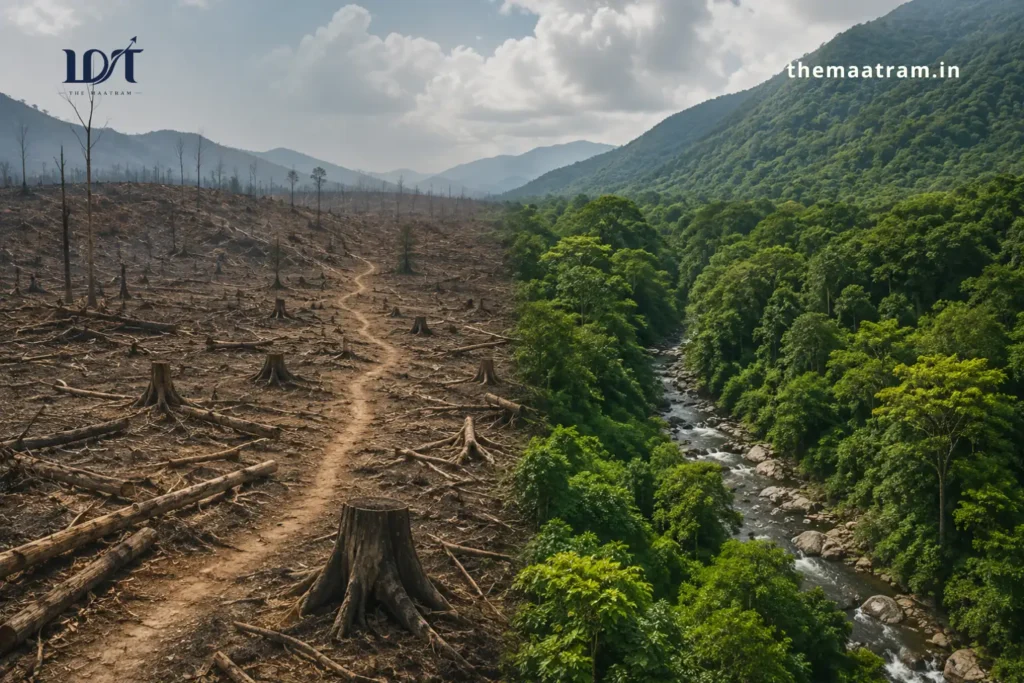
The paper presents detailed data on Tamil Nadu’s forest cover, deforestation rates, and the specific ecological zones under threat. Urban tree plantation emerges as a critical policy gap — with Chennai’s vegetation cover having halved in a decade from 25% to 10%.
The paper presents the ITC agroforestry case study as a model — where farm forestry integrated with existing agricultural land has generated sustainable income for farmers while restoring green cover. A Haryana agroforestry case study demonstrates the economic viability of tree-based farming systems. A retired Tamil Nadu Forest Officer’s inputs identify district-specific native species most suited for plantation — critical for survival rates beyond ceremonial one-day planting events.
An innovative case study from Tiruppur — Vanathukkul Tiruppur — documents how a textile industry-dominated city began integrating green corridors into its urban fabric, providing a replicable model for other Tamil Nadu cities.
Chapter 6: Solid Waste Management — From Crisis to Circular Economy
Tamil Nadu generates enormous quantities of solid waste daily, with urban municipalities struggling to manage collection, segregation, and disposal. The paper documents health hazards from unmanaged waste — Kodungaiyur dump yard in Chennai being specifically identified as a major surface heat and pollution contributor.
Inputs from the President of ExNoRa International Foundation and a solid resource management specialist outline the pathway from linear waste disposal to circular resource management. The key insight: waste is not a problem to be disposed of — it is a resource to be managed.
The Ellen MacArthur Foundation’s circular economy framework forms the intellectual backbone of this section. The framework’s three core principles — eliminate waste and pollution by design, circulate products and materials at their highest value, and regenerate nature — are applied to Tamil Nadu’s context.
The Andhra Pradesh Community-managed Natural Farming (APCNF) programme is presented as a powerful Indian case study in circular agricultural economics. Launched in 2016 and reaching 630,000 farmers by 2022, the programme reduces paid-out costs by 13-43% across different crops while increasing net value output dramatically — cotton farmers saw net value output rise by 914%. The programme is projected to save the state government USD 1 billion annually in fertiliser subsidies when fully scaled. Individual farmers have reported income increases of up to 197%.
A cutting-edge case study on Colorifix — a UK biotech company using synthetic biology to replace toxic textile dyes with bio-based alternatives — is particularly relevant for Tamil Nadu’s textile industry, which is one of the state’s largest employers and one of its biggest sources of water and soil pollution.
Chapter 7: WTL’s Plan of Action — August as Green Month
The paper’s final section outlines a concrete August 2026 environmental movement inspired by Tamil Nadu’s ancient ecological wisdom — the Sangam literature’s five tinais (Kurinji, Mullai, Marutham, Neithal, Paalai) representing five distinct ecological landscapes that Tamil civilisation recognised and respected thousands of years ago.
The ambition is specific and measurable:
- 50 lakh trees planted as a long-term target, with 20 lakh trees planned for August alone
- Emphasis on native species and long-term maintenance rather than ceremonial one-day planting
- The Central Government’s Green Credit Programme — 1 credit per tree planted above 1,100 trees per hectare — provides an economic incentive framework
- Tamil Nadu Government’s Green Tamil Nadu Mission offers free saplings via 1800-5997-634
Four-level programme structure:
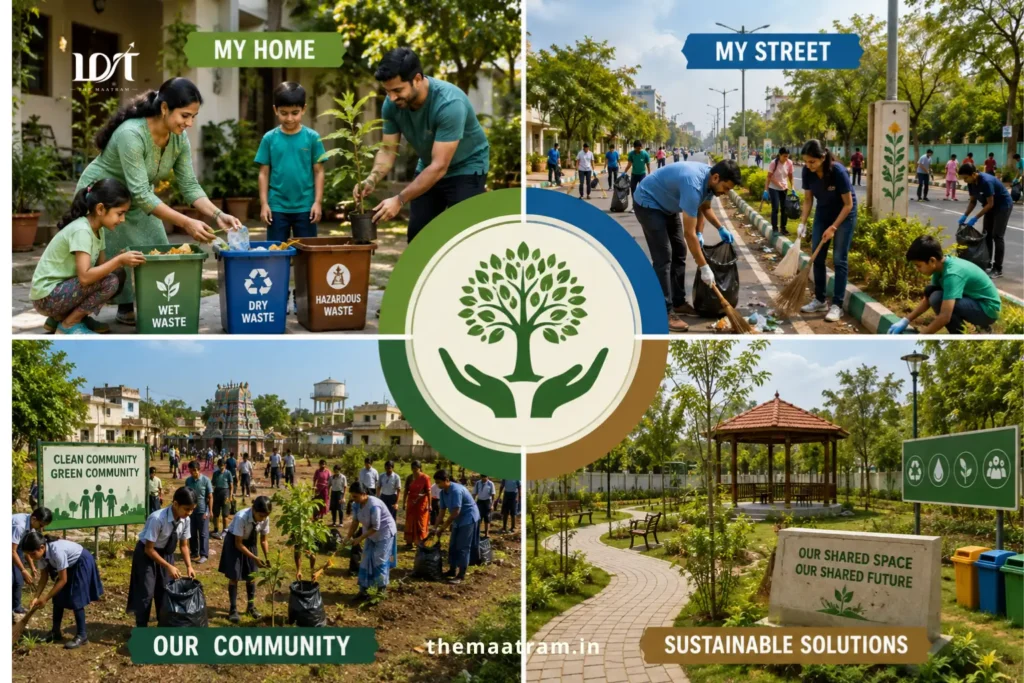
- My Home: Individual families clean surroundings, segregate waste, plant one tree
- My Street: Neighbourhood-level cleanliness and greening drives
- Our Community: Village, ward, and school-level cleanups and tree planting
- Sustainable Solutions: Long-term adoption of shared spaces with continuing action plans
Specific August events confirmed:
- August 2: Beach cleaning in Kanyakumari, Uvari (Tirunelveli), Kulasekarapattinam and Threspuram (Tuticorin) — to be expanded into a year-long coastline programme
- August 3: Cleaning of Vaigai River in Madurai
- August 16: Environmental awareness rally in Chennai
- Sivagangai: Commencement of restoring the dead Thennaru river in Karaikudi
Key Data Points Summary
| Domain | Key Finding |
| Climate | 40% of TN coastline highly vulnerable to sea level rise |
| Urban Heat | Chennai built-up area: 36% (2014) → 67% (2024) |
| Vegetation | Chennai green cover: 25% (2014) → 10% (2024) |
| Groundwater | 60%+ of India’s sources face critical degradation in 20 years |
| Air Quality | Chennai AQI improved from 113.61 (2015) to 74.67 (2025) |
| Soil | 33-40% of world’s soils moderately to severely degraded |
| Soil Loss | 20 hectares lost globally every minute to erosion |
| Dairy | Climate stress reduces milk yield by 20-30% during heat events |
| Natural Farming | Cotton farmers: net value output up 914% under APCNF |
| Trees | Target: 20 lakh trees in August, 50 lakh overall |
The Document’s Central Argument
The paper’s intellectual core is that Tamil Nadu’s environmental crisis cannot be addressed through awareness campaigns alone. The challenges are systemic — embedded in industrial practices, urban planning decisions, agricultural methods, and waste management systems. Solutions must therefore be systemic — combining data-driven policy, community ownership, technological innovation, circular economy principles, and political will.
The paper explicitly avoids blaming any government or political party. It focuses entirely on what needs to be done, drawing from successful models across the world — Telangana’s Mission Kakatiya, Andhra Pradesh’s natural farming programme, Shenzhen’s river restoration, Singapore’s water management, and cutting-edge global innovations like Colorifix’s bio-based textile dyeing.
The vision: Tamil Nadu, with its ancient tradition of environmental stewardship rooted in Sangam literature, can become a model state for sustainable development in India — not by looking outward for solutions but by combining its cultural wisdom with evidence-based modern practice.
Source: This article is an editorial executive summary prepared from the Policy Paper for a Clean & Sustainable Tamil Nadu released by the We the Leaders Foundation. Readers interested in the complete analysis, detailed data, references, and supporting case studies are encouraged to consult the full policy paper.