From New Jersey to Pollachi: Annamalai’s Road to 2031
In just over a month after leaving the BJP, K. Annamalai has done something few political leaders attempt after a high-profile exit—he has shifted the conversation away from his resignation and towards a new political movement. His outreach to the Tamil diaspora, policy-driven messaging, and grassroots mobilisation suggest that his attention is firmly fixed on the next electoral cycle rather than the last.
Most politicians who part ways with a major political party spend the months that follow rebuilding quietly. They manage perceptions, respond to critics, and wait for political circumstances to become favourable again. Public appearances are usually measured, and long-term ambitions remain carefully understated.
K. Annamalai has chosen a markedly different path.
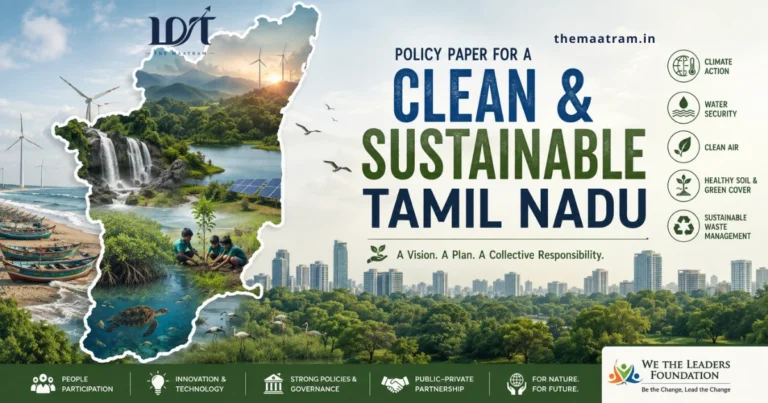
In the forty days since resigning from the BJP on June 5, 2026, he has addressed the Tamil diaspora at the FeTNA Convention in New Jersey, interacted separately with supporters of his newly launched movement, released a comprehensive policy paper on building a Drug-Free Tamil Nadu, and returned to Tamil Nadu to address a massive public gathering in Pollachi.
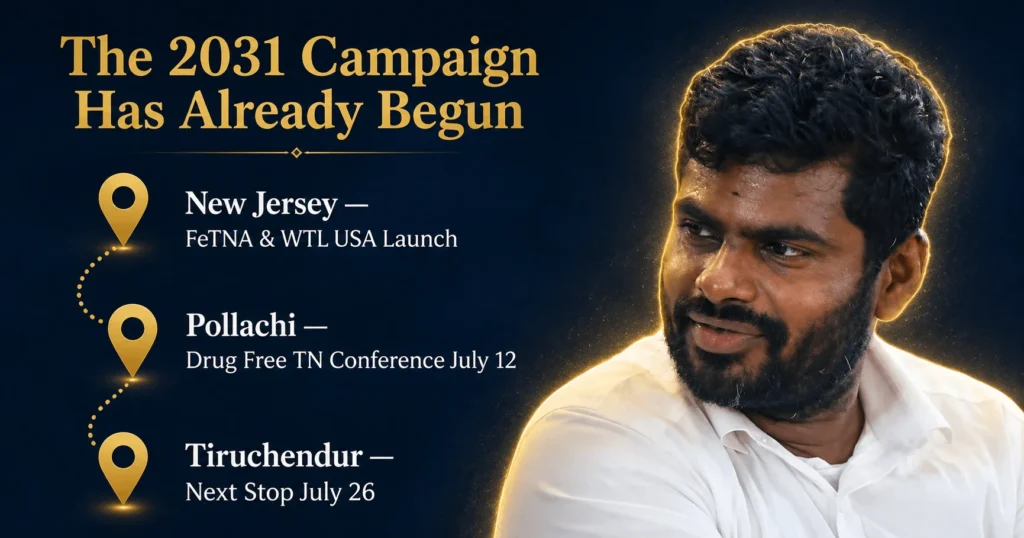
Taken individually, these may appear to be routine political engagements. Viewed together, however, they reveal something more significant—a leader who is investing very little energy in explaining his departure and considerably more in building what comes next.
Rather than looking back at the circumstances that led to his exit, Annamalai appears to have begun laying the foundations for a long political journey, one that he has openly linked to the 2031 Assembly election.
The Diaspora Connect: More Than a Courtesy Visit
One of Annamalai’s earliest public appearances after leaving the BJP was at the 39th Annual FeTNA Convention held in Edison, New Jersey, from July 2 to July 4.
The choice of venue was significant.
The Federation of Tamil Sangams of North America (FeTNA), representing dozens of Tamil organisations across the United States and Canada, is far more than a cultural platform. Over the years it has evolved into an influential meeting point for academics, entrepreneurs, professionals, and community leaders who retain a deep interest in Tamil Nadu’s social, economic, and political development.
For a leader launching a new political movement, addressing this audience at such an early stage was not merely ceremonial. It was an attempt to establish a relationship with a constituency that possesses intellectual capital, professional expertise, financial resources, and global networks.
His speech reflected that ambition.
Instead of limiting himself to nostalgia about Tamil heritage, Annamalai presented a forward-looking interpretation of Tamil identity.
He argued that Tamil was not simply a language to be preserved but a civilisational framework capable of shaping future global leadership. It was a subtle yet important shift—from celebrating the past to discussing the future.
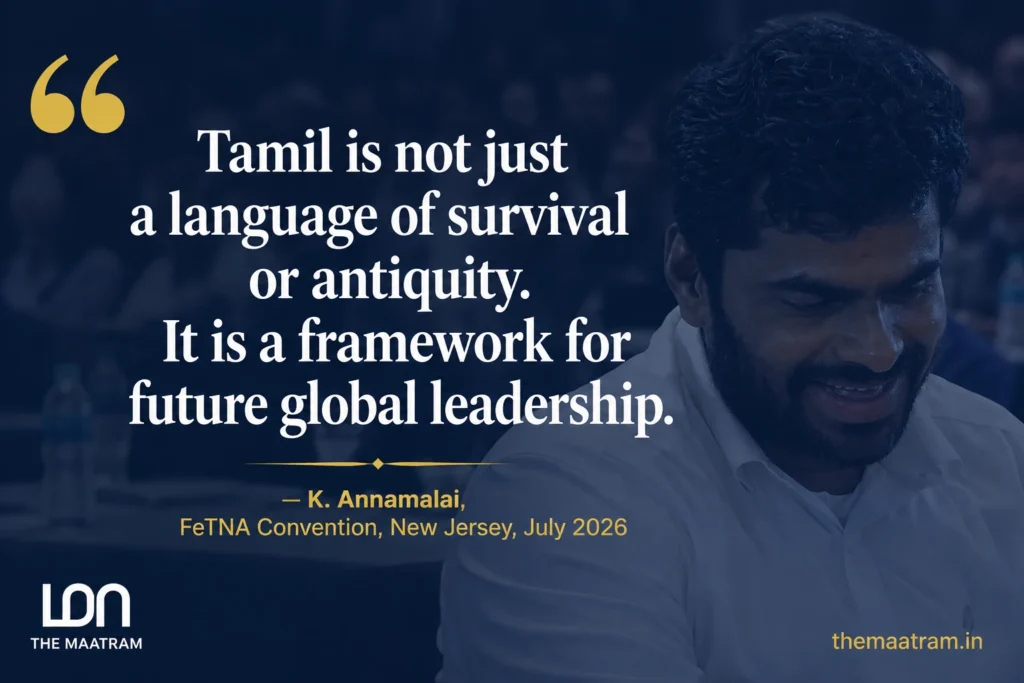
Throughout the address, he praised Tamil-Americans for preserving their language and culture across generations, while also challenging them to think beyond annual cultural gatherings. His appeal was straightforward: the knowledge, experience, and financial strength accumulated by the diaspora should become active contributors to Tamil Nadu’s long-term development.
Infrastructure, education, entrepreneurship, and rural transformation featured prominently in his vision. Tamil identity, in his formulation, was not merely a source of pride; it was a responsibility that could translate into tangible progress.
This approach reflected a broader political strategy. Rather than treating the diaspora as an audience for emotional mobilisation, Annamalai sought to position them as long-term stakeholders in the state’s development.
Keeping Doors Open While Building Something New
Perhaps the most closely watched aspect of the New Jersey visit was how Annamalai would speak about his former party.
Many expected criticism.
Instead, they witnessed restraint.
Even after his departure from the BJP, Annamalai continued to express respect for Prime Minister Narendra Modi and the national leadership. At the same time, he argued that Tamil Nadu’s development would be strengthened through constructive engagement with the Union Government rather than perpetual confrontation.
The messaging was carefully calibrated.
It enabled him to distinguish his new movement from the BJP organisationally without creating the impression of personal bitterness or ideological hostility.
For a leader attempting to build an independent political identity, this approach carries strategic value. It reassures supporters who admired his leadership within the BJP while signalling that his political future will be defined more by governance and policy than by personal disputes.
Whether this balance can be sustained over the coming years remains to be seen, but during the first forty days after his resignation, Annamalai demonstrated considerable discipline in ensuring that the public conversation remained focused on his new movement rather than his former party.
Launching WTL Before a Global Tamil Audience
Following the FeTNA programme, Annamalai met supporters of the ‘We The Leaders’ (WTL) separately in New Jersey.
If the convention speech was aimed at the broader Tamil diaspora, this interaction served a different purpose—it introduced the movement itself.
Here, Annamalai spoke less as a former state BJP president and more as the architect of a new political organisation.
He described WTL as a movement that sought to move beyond personality-driven politics and dynastic structures by creating opportunities for ordinary citizens to participate in leadership.
Invoking the ideals of former President Dr. A.P.J. Abdul Kalam, he spoke of clean governance, institutional strength, merit-based leadership, and policy-oriented politics as the movement’s guiding principles.
One remark stood out.
He told supporters that WTL had already crossed “50 percent of the hardest journey.”
Whether viewed as organisational confidence or political optimism, the statement conveyed an important message: in Annamalai’s assessment, the most difficult phase was not winning elections but creating an organisation capable of surviving beyond one individual.
He also made no secret of his long-term objective.
WTL, he suggested, was not being built to influence immediate political developments or to function as a pressure group. It was being organised with a clear destination in mind—the 2031 Tamil Nadu Assembly election.
That distinction matters.
Many new political movements begin with emotional momentum but struggle to build institutions. Annamalai appears to recognise that sustainable political success requires organisational depth, policy development, leadership cultivation, and consistent public engagement over several years.
By beginning that process immediately after leaving the BJP, rather than waiting for the next election cycle, he has effectively given himself a five-year runway to build an alternative political platform.
Whether that strategy ultimately succeeds will depend on execution rather than intent. But the clarity of the roadmap itself is noteworthy.
Pollachi: The First Rally That Defined the Movement
If the United States visit established WTL’s international narrative, Pollachi became the first real test of its grassroots strength.
Officially described as the Drug-Free Pollachi Awareness Conference, the July 12 gathering at Achipatti carried all the characteristics of a major political event. Thousands assembled from different parts of Tamil Nadu despite the absence of a conventional mobilisation campaign or elaborate political machinery.
That, perhaps, was the most striking aspect of the event.
Unlike established parties that rely on district secretaries, booth committees, and extensive logistical coordination, WTL was known to the larger world barely five weeks ago. Yet supporters travelled considerable distances to attend, many organising themselves through informal networks and digital communication rather than formal party channels.
Former BJP State Secretary Amar Prasad Reddy, now associated with WTL, remarked that even core committee members had not been individually called to attend. Whether one accepts that assessment in full or not, the turnout reflected an undeniable level of public curiosity surrounding Annamalai’s next political chapter.
Political movements are rarely judged by attendance alone. Crowds can be organised, enthusiasm can fluctuate, and momentum can fade.
Yet first impressions matter.
Pollachi suggested that Annamalai’s personal appeal had survived his departure from the BJP and, more importantly, that a section of the public was willing to engage with his new political experiment before it had acquired the organisational advantages of a conventional party.
Speaking About the BJP Without Looking Back
One of the most anticipated moments of the Pollachi address was Annamalai’s explanation of his departure from the BJP.
Many expected criticism.
Instead, they heard reflection.
He acknowledged that he had experienced differences with the party and even admitted that he had been angry. But he immediately added that those emotions had been handled with responsibility and that, in the weeks since establishing WTL, he had deliberately avoided speaking against his former organisation.
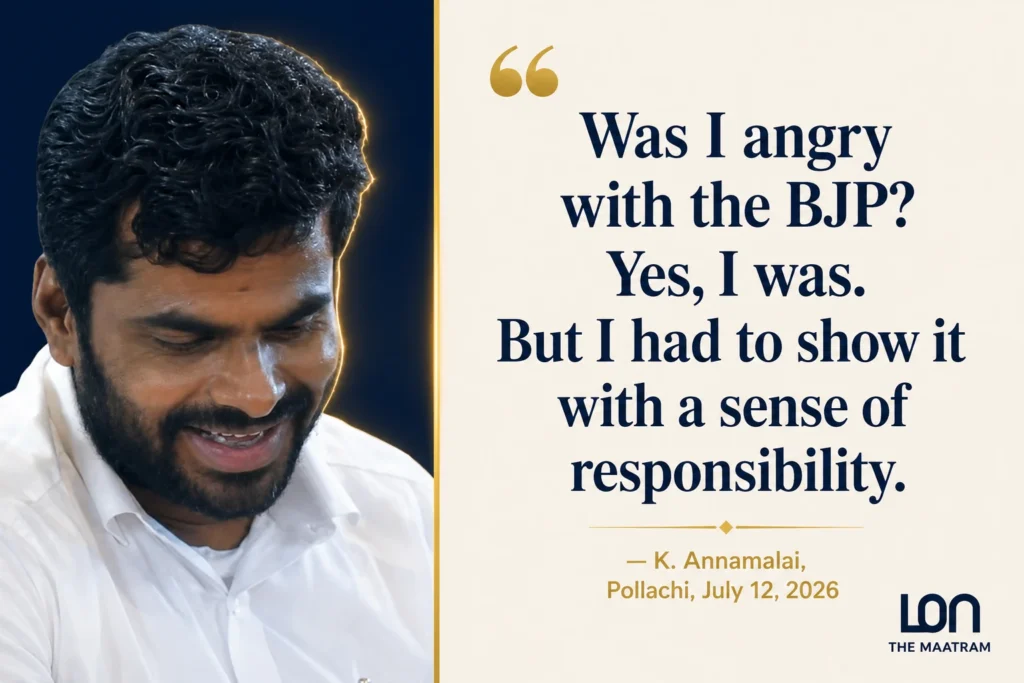
The distinction was important.
Indian politics is filled with examples of leaders who leave parties only to spend years defining themselves through criticism of their former colleagues.
Annamalai appears to have chosen a different course.
Rather than asking voters to support WTL because he rejected the BJP, he is asking them to evaluate WTL on its own vision, organisational culture, and policy priorities.
From a strategic perspective, that approach allows him to retain goodwill among former supporters while expanding his appeal to voters who may never have identified with the BJP but are open to an alternative political platform.
It is a more difficult path, but potentially a more durable one.
Redefining Faith in Tamil Nadu’s Political Vocabulary
Among the most discussed portions of the Pollachi speech were Annamalai’s remarks on religion.
He described himself as a practising Hindu but added that when he stepped into public life, his caste and religion remained private matters rather than political identities. He went further, arguing that genuine Hindu philosophy emphasises equality, social harmony, and collective progress rather than superiority or exclusion.
These comments deserve attention because they represent an important evolution in political messaging.
Tamil Nadu’s electorate has historically combined strong religious faith with scepticism towards overt religious mobilisation in electoral politics. Success has often belonged to leaders who could respect personal belief while focusing public debate on governance, welfare, development, and administration.
Annamalai’s remarks appeared designed to occupy precisely that space.
Rather than diluting his personal convictions, he separated individual faith from organisational identity.
That distinction became even clearer when he stated that religion would have no formal role within WTL and that the movement’s central objective was to build a better-governed Tamil Nadu.
Whether critics accept this positioning or not, it represents a conscious attempt to broaden WTL’s appeal beyond traditional ideological boundaries.
For a movement seeking long-term growth, such positioning may prove politically significant.
A Movement Betting on Youth
Another revealing aspect of the Pollachi address was Annamalai’s emphasis on demographics.
He noted that more than half of WTL’s members are below the age of thirty-five and highlighted the growing participation of first-time and young voters.
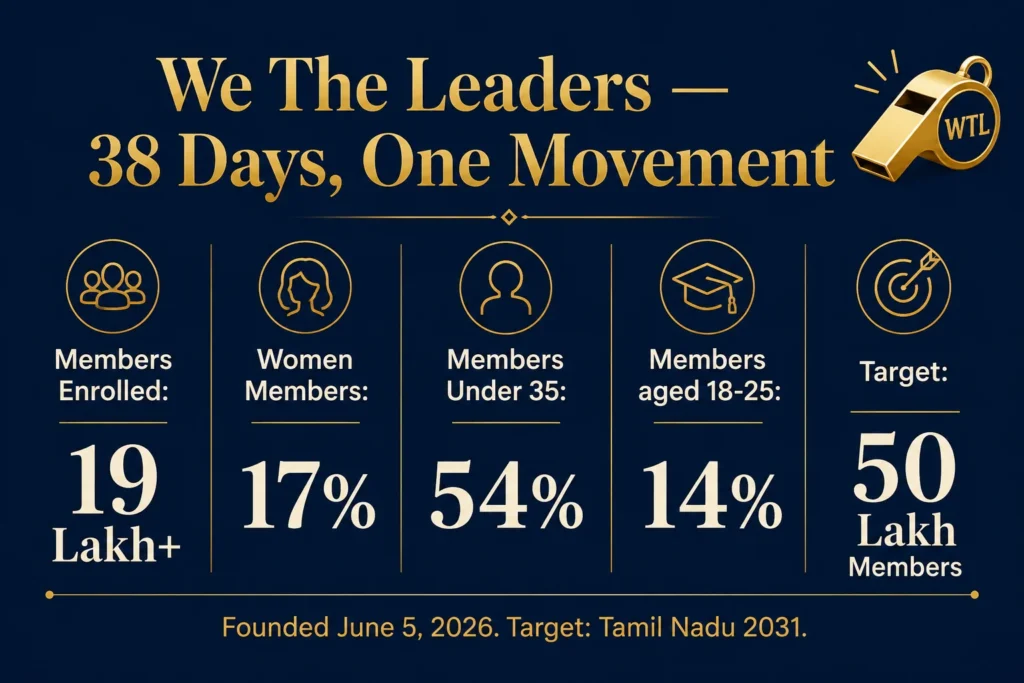
This was not merely an organisational statistic. It reflected his reading of Tamil Nadu’s political future.
The 2026 Assembly election demonstrated that younger voters are becoming increasingly influential in shaping electoral outcomes. Digital communication, issue-based campaigns, entrepreneurship, employment, education, and governance reforms resonate more strongly with this generation than traditional ideological debates.
Annamalai appears determined to position WTL within that changing political landscape.
His repeated references to leadership development, volunteer participation, policy discussions, and citizen engagement suggest that he wants WTL to be seen less as a conventional political party and more as a movement capable of attracting politically unaffiliated young professionals.
Whether that aspiration translates into sustained electoral support remains uncertain.
But identifying and investing in this demographic five years before the next Assembly election demonstrates a longer planning horizon than is usually associated with newly formed political organisations.
Why Pollachi Matters
Pollachi was not simply a convenient venue.
It carried symbolism.
Situated in Coimbatore district, the region has long been associated with Annamalai’s political journey. Holding WTL’s first major public programme there ensured familiarity, organisational comfort, and local enthusiasm.
But Pollachi also carries another association.
Over the past decade, the town has frequently appeared in public discourse because of issues relating to crime, law enforcement, and social safety.
Launching a campaign centred on a Drug-Free Tamil Nadu from this location therefore carried a message beyond geography. It suggested that WTL intended to engage with difficult governance issues directly rather than beginning with politically comfortable themes.
Whether one agrees with the proposed solutions or not, the symbolism was unmistakable.
Building More Than a Political Party
Taken together, the events in New Jersey and Pollachi reveal a broader organisational strategy that extends beyond conventional electoral politics.
The first pillar is international engagement.
By connecting with the global Tamil diaspora early, Annamalai is attempting to build relationships that could eventually contribute ideas, expertise, investment, and institutional support to the movement.
The second pillar is policy.
Instead of waiting for elections to release promises, WTL has begun publishing issue-based policy documents, launching thematic campaigns, and framing public conversations around governance challenges.
The third pillar is grassroots expansion.
Public meetings, awareness campaigns, volunteer recruitment, and district-level engagement are steadily giving the movement a physical presence across Tamil Nadu.
Individually, none of these elements is unique. Together, however, they form a coherent organisational blueprint.
Rather than treating politics as a sequence of election campaigns, Annamalai appears to be approaching it as a long-term institution-building exercise. That may ultimately become WTL’s defining strength—or its greatest challenge.
Either way, it deserves closer attention than it has received so far.
The Verdict
Political history is filled with leaders who mistook public enthusiasm for organisational strength. It is equally filled with movements that quietly built institutions long before they became electoral forces. Which category WTL eventually belongs to will only become clear over the next five years.
But the first forty days after Annamalai’s departure from the BJP have already revealed one important characteristic.
He has shown little interest in fighting yesterday’s battles.
Instead of spending months defending his resignation, responding to criticism, or settling political scores, he has chosen to speak about governance, youth participation, public policy, and long-term organisation building.
That shift in focus may prove more consequential than the resignation itself.
There is, of course, no guarantee that WTL will emerge as a major political force by 2031. Building a successful political movement requires far more than public meetings, compelling speeches, or initial enthusiasm. It demands organisational discipline, credible leadership at every level, policy consistency, and the ability to sustain public trust over time.
Yet dismissing the movement at this stage would be equally premature.
Within just forty days, Annamalai has addressed the global Tamil diaspora, launched policy initiatives, attracted significant volunteer interest, and demonstrated that his personal political appeal extends beyond the structure of the BJP.
For most leaders, leaving a major political party marks the beginning of political uncertainty. For Annamalai, it increasingly appears to have marked the beginning of a new political project. Whether that project succeeds will be decided by the people of Tamil Nadu in the years ahead.
But if the first forty days are any indication, Annamalai is no longer fighting to explain his past.
He is attempting to shape the conversation about Tamil Nadu’s future.