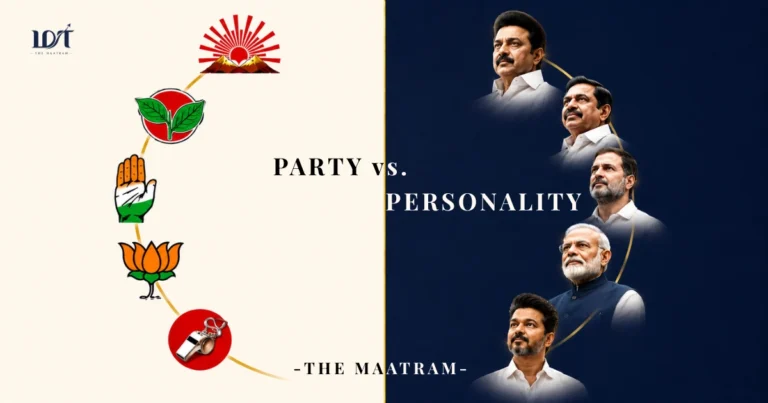

While BJP Calls Him a Failure, Annamalai is Writing Policy for Tamil Nadu’s Future
There is a revealing contrast playing out in Tamil Nadu’s political landscape this July.
On one side, BJP leaders and aligned social media voices are spending considerable energy attacking K. Annamalai — questioning his motives, calling him a traitor, and relitigating his five years in the party. The most prominent voice among them is former Tamil Nadu BJP president and former Telangana Governor Dr. Tamilisai Soundararajan, who told Vikatan Digital in a pointed interview that after everything the party gave Annamalai — full organisational structure, central leadership support, a platform — he could not deliver results and let the party down.
On the other side, Annamalai has released a 41-page, evidence-based policy paper on making Tamil Nadu drug-free. He has addressed Tamil diaspora at the FeTNA conference in the United States. He has met WTL supporters in New Jersey. He has scheduled ground meetings in Pollachi on July 12 and Tiruchendur on July 26. His movement has crossed 18.94 lakh members and is still climbing.
The Maatram leaves it to readers to decide which side of that contrast looks like a “failure.”
The Drug Crisis — What the Numbers Actually Say
Before examining what Annamalai is proposing, it is important to understand the problem he is addressing. The WTL policy paper — titled Drug-Free Tamil Nadu and presented by the We the Leaders Foundation — opens with Tamil Nadu-specific data that should alarm every citizen regardless of political affiliation.
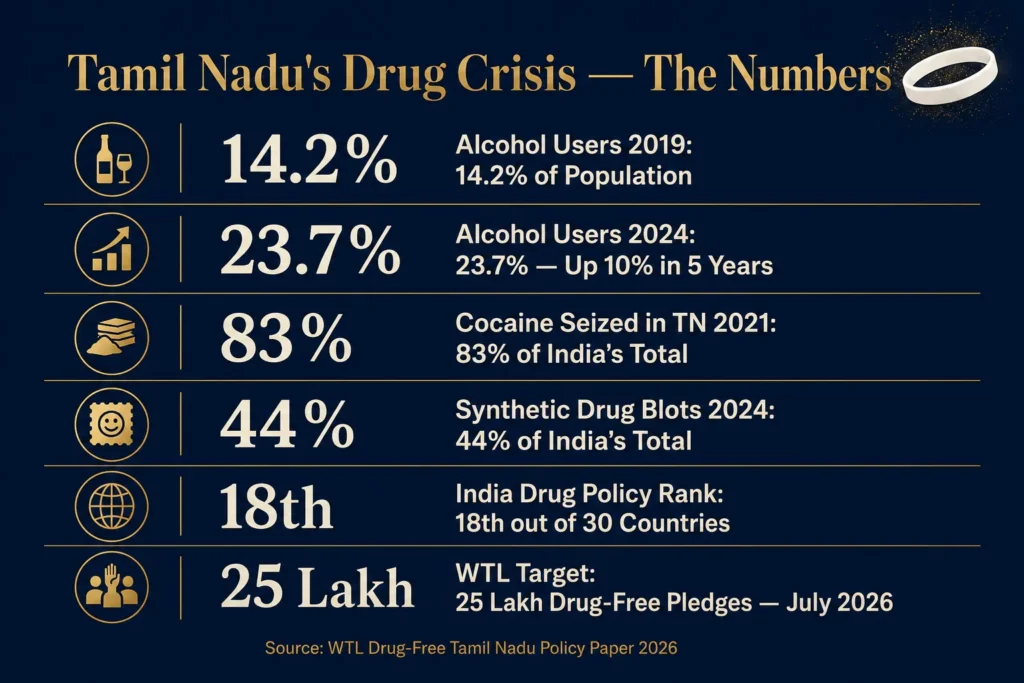
Tamil Nadu’s alcohol consumption stood at 14.2 percent of its population in 2019. By 2023-24, that figure had jumped to 23.7 percent — a staggering increase of nearly 10 percentage points in five years. The state ranks third nationally in alcohol consumption, behind only Uttar Pradesh and Andhra Pradesh.
On narcotics, the picture is equally alarming. In 2021, Tamil Nadu accounted for 83.24 percent of all cocaine seized in India — 303 kg out of a national total of 364 kg. In 2024, the state seized 43.66 percent of all synthetic drug blots confiscated nationwide. Tamil Nadu’s eastern coastline is specifically identified as a major entry point for synthetic drugs originating from the Death Triangle — the Myanmar-Thailand-Laos narcotics belt.
Drug-related crimes documented in the paper span Madurai, Kallakurichi, Thanjavur, Tuticorin, Chennai, Tiruvallur, Salem and Tirunelveli — cutting across every region of the state. This is not a localized problem. It is statewide, accelerating, and affecting schools, colleges, workplaces, and communities across all economic backgrounds.
India as a whole ranks 18th out of 30 countries in the Global Drug Policy Index with a score of 46 out of 100 — and scores just 11 out of 100 on harm reduction funding. The system is punitive where it needs to be therapeutic, and absent where it needs to be present.
What Annamalai is Actually Proposing
The policy paper is not a political manifesto. It does not attack any party or government. It is a structured, referenced, solution-oriented document that draws on global models and applies them to Tamil Nadu’s specific context.
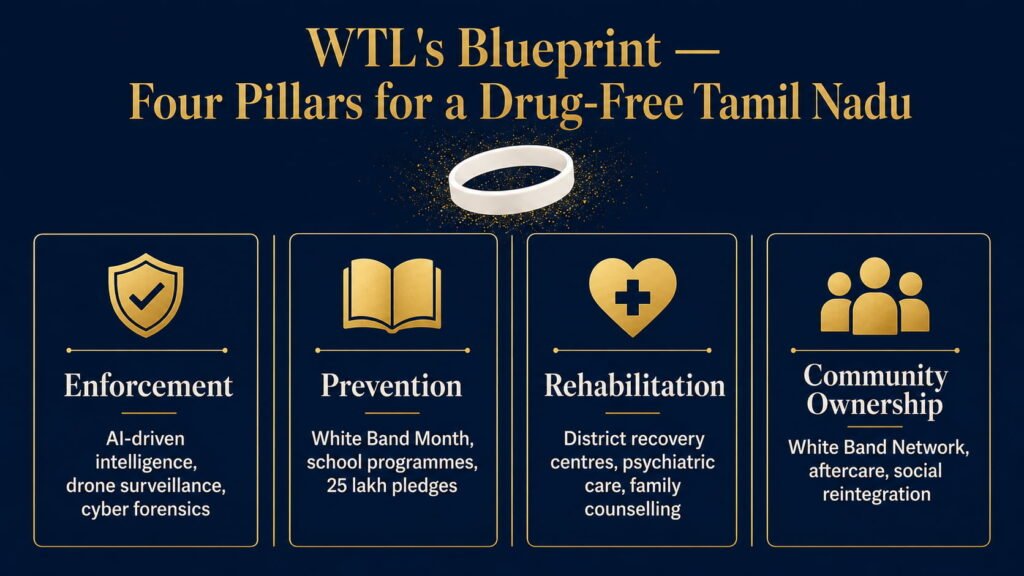
The paper proposes a Four-Pillar Framework modelled on Singapore’s internationally recognized approach to drug eradication — one of the most successful in the world despite Singapore being situated near the Death Triangle itself.
The first pillar is enforcement — strengthening Tamil Nadu’s Enforcement Bureau CID with specialized skills in cyber forensics, financial crime detection, AI-driven intelligence analysis, and interstate coordination. The paper specifically recommends drone surveillance of cannabis cultivation in hill areas and digital tracking of organised crime networks.
The second pillar is prevention through the White Band Movement. WTL proposes declaring July as White Band Month annually, under the theme “Choose Life. Reject Drugs.” Citizens wear a white band as a visible public commitment to drug-free living — drawing from the proven psychology of the US Red Ribbon Week campaign, which succeeded precisely because it gave public ownership of the narrative to communities rather than politicians. The target is 25 lakh public pledges in July alone, and one crore pledges annually within five years.
The third pillar is rehabilitation — not punishment for users, but structured recovery. The paper calls for Integrated Drug Rehabilitation Centres in every district, offering medical treatment, psychiatric care, behavioural therapy, family counselling, and vocational training. The distinction is clear and important: traffickers face enforcement, users receive rehabilitation.
The fourth pillar is community ownership and aftercare — building a Tamil Nadu White Band Network of volunteers, former addicts, educators, employers, healthcare professionals, and youth leaders to sustain anti-drug efforts year-round. Drawing from Singapore’s Yellow Ribbon Project, the paper proposes a structured reintegration scheme that treats recovery as a lifelong process, not an event.
The paper also examines Telangana’s EAGLE model — the Elite Action Group for Drug Law Enforcement launched in June 2025 — which uses AI tools like Shield AI and Sahay AI for early detection of substance abuse and behavioral risk assessment. Within months of launch, EAGLE registered 336 narcotics cases, arrested 447 individuals, and ran 57 awareness campaigns. This is the kind of technology-driven, community-integrated enforcement that Tamil Nadu currently lacks.
The Five-Year Roadmap
What distinguishes this paper from political speechmaking is the five-year roadmap from 2026 to 2031 — with year-by-year targets. Year One focuses on institutional infrastructure — launching White Band Month, strengthening enforcement capabilities, creating district anti-drug committees, and integrating preventive education into schools. By Year Five, the goal is to publish an independent impact assessment and establish Tamil Nadu as a national model for integrated narcotics prevention.
This is not a promise. It is a plan. With benchmarks. With referenced data. With global comparisons. Whether one agrees with Annamalai’s politics or not, the intellectual seriousness of this document deserves acknowledgment.
July, Pollachi, Tiruchendur — Taking It to the Ground
Annamalai has declared July as Fight Against Drugs month for the WTL movement. The Pollachi meeting on July 12 is significant — Pollachi has its own well-documented history with crime and social disruption. Choosing Pollachi as the first ground event for the anti-drug campaign is not accidental. It is a deliberate signal that this campaign will go where the problem is most acute.
The Tiruchendur meeting on July 26 takes the campaign to southern Tamil Nadu — a region historically anchored in politics. The choice of Tiruchendur — a constituency with deep cultural and religious significance — reflects an understanding that anti-drug messaging in Tamil Nadu cannot be purely administrative. It must connect with community identity.
A Note on the “Failure” Charge
Dr. Tamilisai Soundararajan is an experienced politician with decades of service in the BJP. Her critique of Annamalai deserves to be engaged with seriously, not dismissed.
But here is the context The Maatram feels obligated to provide. Dr. Tamilisai Soundararajan herself has contested assembly and parliamentary elections multiple times without winning a seat. She served as Tamil Nadu BJP president before Annamalai. During her tenure, the party’s vote share in Tamil Nadu remained in the 2-3 percent range. It was under Annamalai that it grew to 11 percent.
Calling someone who grew your party’s vote share from 3 to 11 percent a “failure” — while releasing a 41-page policy document on Tamil Nadu’s drug crisis — requires a specific definition of the word failure that The Maatram does not recognise.
The Verdict
What is happening in July 2026 is not complicated. One man has left a political party, built a movement of 18.94 lakh people in weeks, presented a serious policy framework to address one of Tamil Nadu’s most urgent social crises, engaged the Tamil diaspora internationally, and is now taking his agenda to the ground in Pollachi and Tiruchendur.
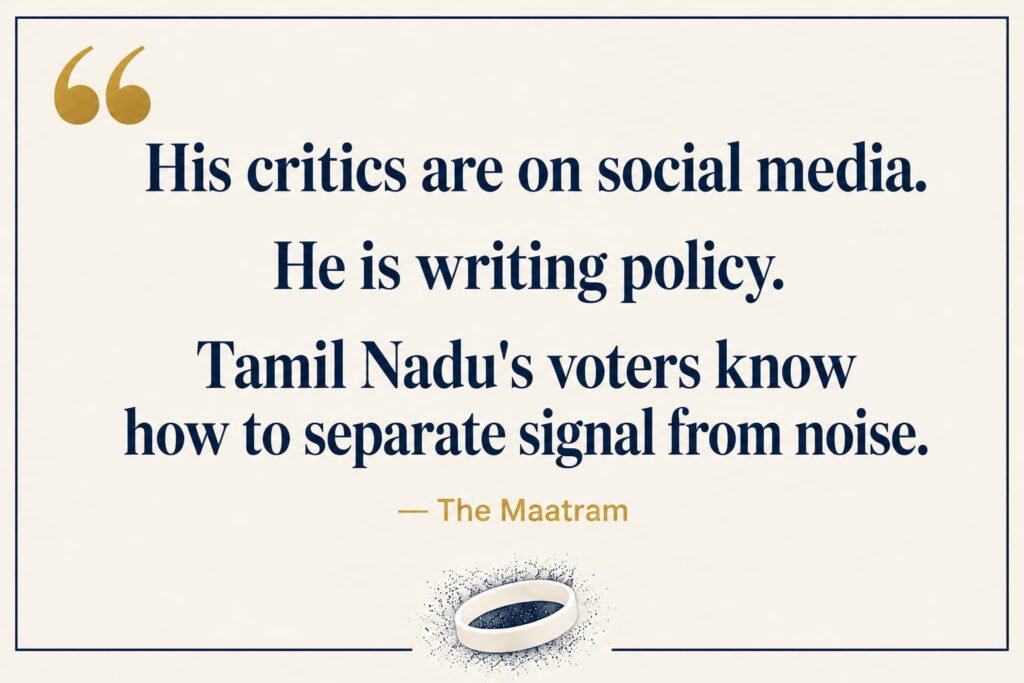
His critics are on social media.
Tamil Nadu’s voters — who delivered an 85.1 percent turnout in April, the highest in the state’s history — are watching both sides. They have already demonstrated once this year that they know how to separate signal from noise.
The Maatram suspects they will do so again.