Udhayanidhi Stalin — Leader of Opposition or Leader in Waiting?
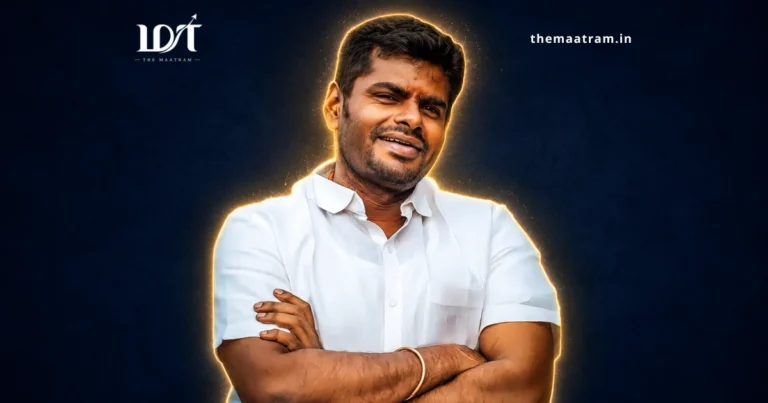
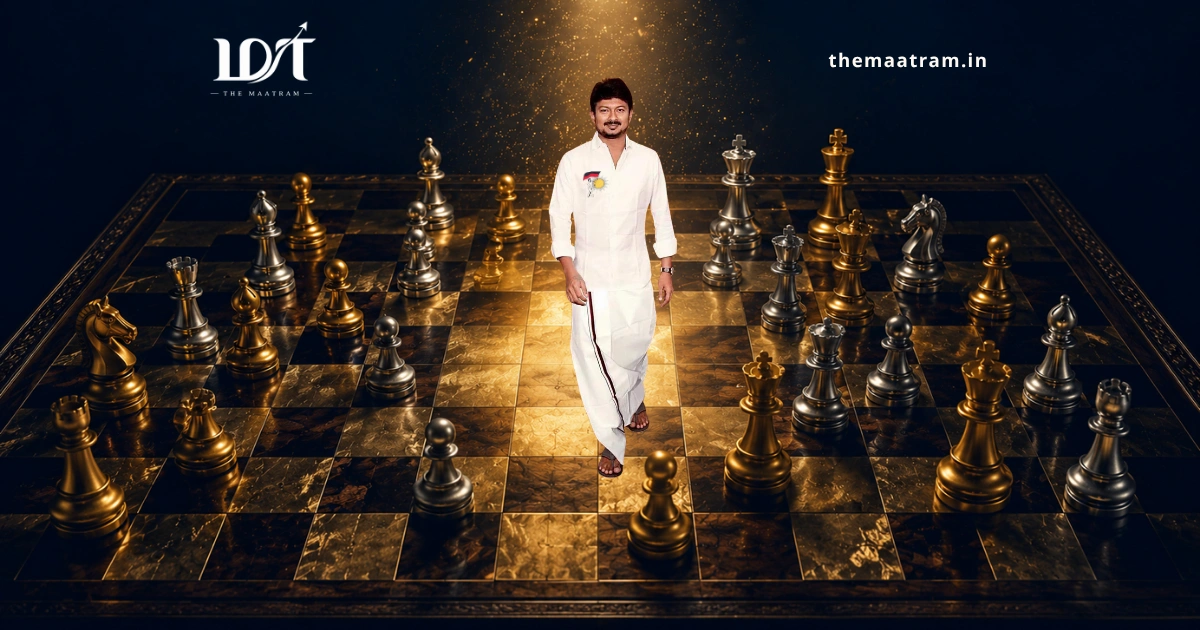
In Tamil Nadu’s post-2026 political landscape, one figure occupies a uniquely complex position. He is simultaneously the son of a man who just lost his own assembly seat, the heir to a political dynasty that built modern Tamil Nadu, and the official Leader of Opposition in the state assembly. He is 48 years old, once a film producer and actor, and now the most consequential DMK leader sitting inside the Tamil Nadu assembly.
Udhayanidhi Stalin‘s journey to the Leader of Opposition chair is a story that contains multitudes — ambition and inheritance, genuine achievement and avoidable controversy, real political potential and the persistent shadow of privilege. The Maatram examines all of it, without flinching from the uncomfortable parts and without denying the legitimate ones.
From Red Giant Movies to the Assembly Floor
Udhayanidhi did not arrive in politics through the traditional route of party work, street campaigns, and organisational climbing. He arrived through cinema. His production company Red Giant Movies became one of Tamil cinema’s most prominent banners, and he acted in several films himself. The film industry gave him a public profile, a youth connect, and a brand identity that most politicians spend decades trying to build.
In 2019, he was appointed Secretary of DMK’s Youth Wing — his formal political entry. Two years later, in the 2021 assembly elections, he contested from Chepauk-Thiruvallikeni and won with a commanding 67.89 percent vote share. In December 2022, just eighteen months after his first electoral victory, he was appointed Minister for Youth Welfare and Sports Development. By 2024, he had been elevated to Deputy Chief Minister — the youngest person in Tamil Nadu’s history to hold that position.
The speed of that ascent is breath-taking by any measure. And it is the first thing that needs to be addressed honestly.
Dynastic Politics — India’s Universal Reality, Not DMK’s Exception
Critics have pointed to Udhayanidhi’s rise as a textbook example of dynastic politics — the son getting what thousands of loyal party workers could never access regardless of their service or ability. It is a fair observation. Senior leaders like K.N. Nehru, who won his constituency in 2026 and remains a respected presence in the assembly, were never considered for the Leader of Opposition role despite their longer service and deeper organisational roots.
But The Maatram wants to offer a perspective that is rarely articulated in political discourse.
Dynastic succession in politics is not inherently different from dynastic succession in business. The Ambanis run Reliance. The Adanis run the Adani Group. The Tatas have maintained family leadership for over a century. The Jindals, the Birlas, the Mahindras — India’s most successful institutions have been built and sustained by families who passed leadership from one generation to the next. We do not condemn these transitions as illegitimate. We evaluate them by their outcomes.
In Indian politics, no family has practised dynastic succession more visibly than the Nehru-Gandhi family. Jawaharlal Nehru was India’s first Prime Minister. His daughter Indira Gandhi became Prime Minister twice. Her son Sanjay Gandhi was being groomed as the political heir before his untimely death. Her other son Rajiv Gandhi then became Prime Minister. Rajiv’s widow Sonia Gandhi took over the Congress presidency in 1998 and held it for two decades, keeping the party alive through successive defeats.
Their son Rahul Gandhi and daughter Priyanka Gandhi Vadra now carry the family’s political legacy into a fourth generation. The Congress is inseparable from the Nehru-Gandhi family — it has been that family’s political vehicle for over seven decades. Voters have elected and rejected this dynasty repeatedly — on their own terms, based on performance.
Indian politics itself is full of such examples — and they span every ideology and every region.
In Uttar Pradesh, Mulayam Singh Yadav built the Samajwadi Party from the ground up, and Akhilesh Yadav now leads it into every election cycle.
In Bihar, Lalu Prasad Yadav’s RJD is now effectively steered by his son Tejashwi.
In Andhra Pradesh, N. Chandrababu Naidu — himself a son-in-law who entered politics through family connection — has now elevated his son Nara Lokesh to a prominent cabinet role.
In Telangana, K. Chandrashekar Rao built the BRS from scratch and positioned both his son K.T. Rama Rao and daughter K. Kavitha as the party’s future faces.
In Maharashtra, Sharad Pawar — one of India’s most experienced political strategists — has his nephew Ajit Pawar and daughter Supriya Sule both carrying the family’s political legacy in different directions.
Ram Vilas Paswan, who built the LJP into a decisive force in Bihar politics, has his son Chirag Paswan now leading the party with considerable national influence.
In every case, the founding generation built something — and the next generation inherited it. Whether that inheritance produces good politics depends entirely on what the successor does with it — not on the fact of succession itself.
And here is where the argument becomes particularly interesting — because the BJP, which has made opposing dynastic politics a central campaign theme under Prime Minister Modi, has its own substantial list of political inheritors.
Former Union Minister for Sports and Information and Broadcasting Anurag Thakur is the son of former Himachal Pradesh Chief Minister Prem Kumar Dhumal.
Piyush Goyal, Union Minister for Commerce and Industry, is the son of late Ved Prakash Goyal — longtime BJP national treasurer and Union Minister for Shipping under Vajpayee — and his mother Chandrakanta Goyal was a three-term BJP MLA from Maharashtra. A political family on both sides.
Jyotiraditya Scindia, Union Minister for Communications and Minister for Development of North Eastern Region, is the son of late Madhavrao Scindia and grandson of the late Vijayaraje Scindia — a three-generation political dynasty that has served both Congress and BJP.
In Karnataka, B.Y. Vijayendra — son of former four-time Chief Minister B.S. Yediyurappa — now serves as the BJP’s state president and MLA from his father’s own constituency of Shikaripura.
Maneka Gandhi and Varun Gandhi — themselves part of the Nehru-Gandhi lineage — have served as BJP parliamentarians.
The irony, as political observers have noted, is striking: the BJP’s battle cry against parivarvaad — dynastic rule — sits in direct contradiction to its own practice of promoting political inheritors whenever electoral arithmetic demands it. This is not a criticism of the BJP alone. It is simply an observation that dynastic politics is India’s universal political reality — cutting across ideology, geography, and party affiliation.
The DMK is not an exception to this rule. It is simply the most transparent about it.
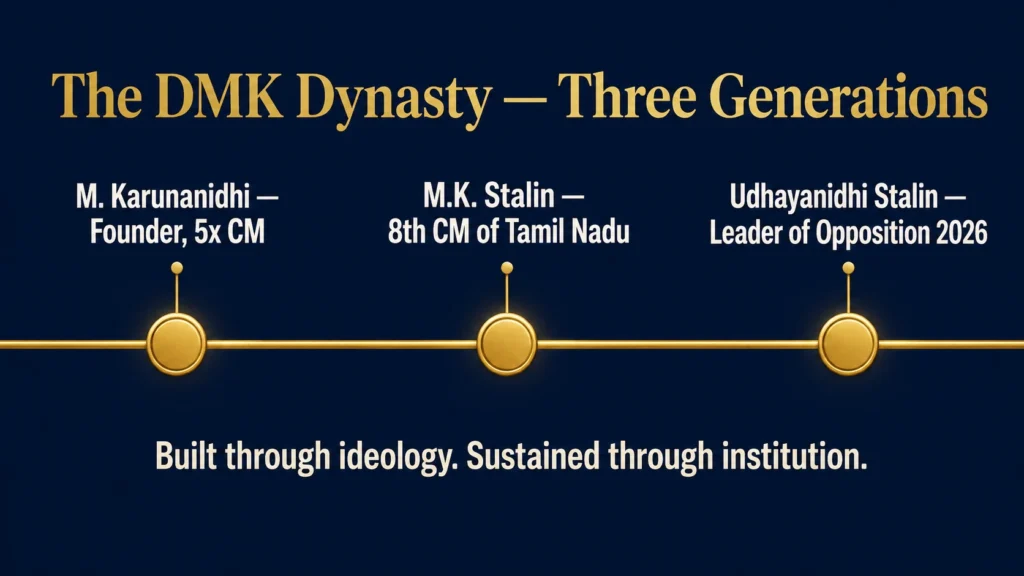
The DMK is not merely a political party. It is an institution — built over seven decades through the extraordinary vision of M. Karunanidhi, sustained through splits that would have destroyed lesser organisations. When MGR broke away in the 1970s to form the AIADMK, it should have been the end of the DMK. When Vaiko left to form the MDMK, it should have weakened the party fatally. It survived both because Karunanidhi held the ideological and organisational core together with an iron grip.
That institution was passed to Stalin. And now, incrementally, it is being prepared for Udhayanidhi. Whether one agrees with the politics or not, the institutional continuity that dynastic succession provides has kept the DMK alive and relevant when most other parties of its era have either disappeared or fractured beyond recognition.
The question is therefore not whether Udhayanidhi deserves his position by some abstract measure of merit. The question is what he does with it.
The Controversies That Cannot Be Ignored
To give Udhayanidhi a fair analysis, The Maatram must also address the controversies that have defined public perception of him — because they are self-inflicted and strategically costly.
The Sanatana Dharma remark of 2023 — comparing it to diseases like malaria and dengue that must be eradicated — triggered a national political firestorm. The Supreme Court of India took suo moto cognisance, issued notice to him personally, and rebuked him for misusing his freedom of speech as a serving minister. He repeated the remark in his maiden speech as Leader of Opposition in May 2026 — reigniting national debate immediately.
The Maatram’s position on this is straightforward. Critiquing caste discrimination and its philosophical underpinnings is a legitimate and honourable tradition rooted in the legacy of Periyar and Ambedkar. But the language used — comparing a religious-philosophical system to infectious diseases — was inflammatory, imprecise, and strategically counterproductive. It allowed opponents to shift the debate from caste justice to religious sentiment, a shift that cost the DMK significant ground among voters who hold both anti-caste values and religious identity simultaneously.
In 2021, Udhayanidhi drew sharp criticism for remarks he made about the deaths of former Union ministers Sushma Swaraj and Arun Jaitley — two of India’s most respected political figures who died after prolonged illness. His comments were widely perceived as imputing political motives behind their deaths — a line that most political observers, regardless of party affiliation, considered inappropriate and unbecoming of a public representative. The Election Commission of India received complaints, and the episode became an early signal of a pattern — Udhayanidhi’s instinct to push rhetorical boundaries without always calculating the human cost of doing so.
Similarly, his remarks about EPS and his comments about the AIIMS proposal for Tamil Nadu generated more heat than light. Political combativeness is a legitimate tool. Foul-mouthed personalisation is not. It reduces a serious politician to a social media provocateur — and Tamil Nadu’s voters, as the 2026 election demonstrated, are sophisticated enough to notice the difference.
2026 — The Election That Redefined Udhayanidhi’s Role
The 2026 assembly election was transformative for the DMK in ways that directly shaped Udhayanidhi’s current position. The party won 59 seats — enough to be the principal opposition but far short of what its alliance arithmetic had promised. MK Stalin lost his own Kolathur seat — a shock result that no one in the DMK had prepared for.
Udhayanidhi, however, won Chepauk-Thiruvallikeni with a solid margin. In a family that suffered its most visible electoral defeat in decades, he was the one who held his ground. That personal electoral credibility — combined with DMK’s 59-seat tally giving it the second largest group in the assembly — made him the logical choice for Leader of Opposition.
That senior leaders like K.N. Nehru, with far longer legislative experience, were passed over is undeniable. The decision reflects the DMK’s institutional logic — building Udhayanidhi’s profile for the longer leadership journey — rather than pure meritocracy. The Maatram has acknowledged why dynastic logic operates this way. But it also notes that Udhayanidhi will need to earn the respect of those senior colleagues through performance, not assume it through position.
The Road Ahead — A Strategic Blueprint
This is where The Maatram wants to spend the most time. Because the Leader of Opposition role, handled well, can be genuinely transformative for Udhayanidhi’s political future. Handled poorly, it can permanently define him as a privileged lightweight. The choice is entirely his.
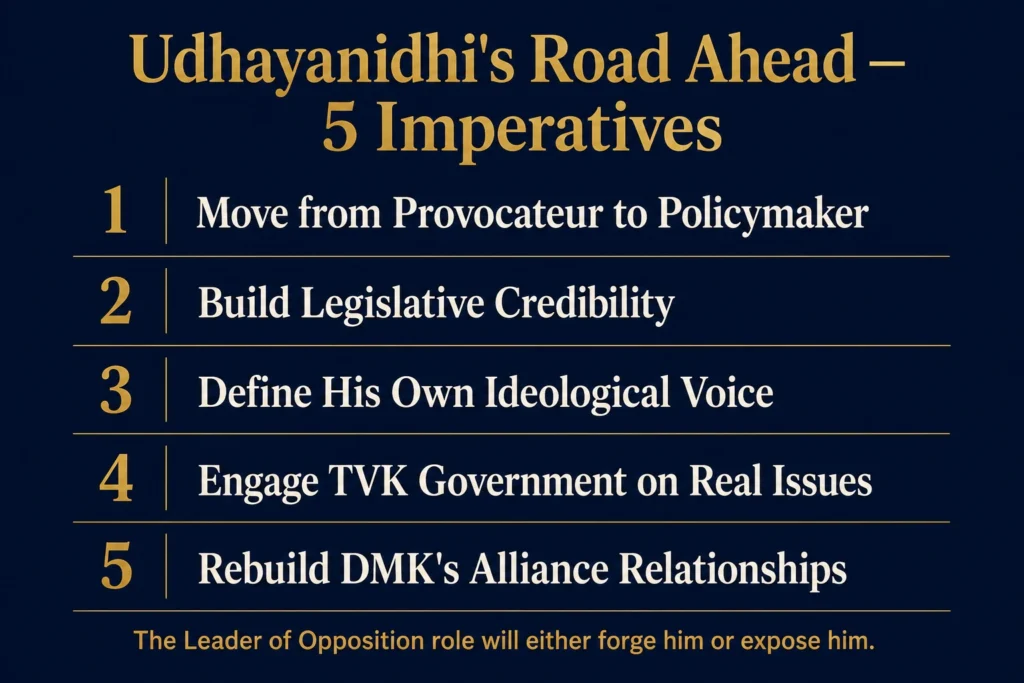
The first imperative is to move from provocateur to policymaker. The Sanatana Dharma controversy may have energised a specific base, but it alienated the broader Tamil Nadu voter who delivered 85.1 percent turnout for a different kind of politics in 2026. The LoP role demands substantive engagement with governance — budget allocations, welfare delivery, law and order, fiscal management. Every time Udhayanidhi chooses a sharp governance critique over a inflammatory social media moment, he grows. Every time he does the reverse, he shrinks.
The second is to build legislative credibility. The assembly floor is a different arena from a press conference or a Twitter post. It demands preparation, data, and the ability to engage ministers on the specifics of policy. Udhayanidhi needs a serious research and policy team backing every assembly intervention. The standard he should set for himself: every question he raises in the assembly should be one that the government cannot dismiss as politically motivated because it is grounded in verifiable data.
The next is to define his own ideological voice. He has inherited Periyar’s rationalism and Karunanidhi’s Dravidian framework. But Tamil Nadu in 2026 is not the Tamil Nadu of 1967. The electorate that voted TVK into power is young, aspirational, digitally connected, and simultaneously holds Dravidian values and modern governance expectations. Udhayanidhi needs a political identity that speaks to this generation — not just inherited ideology but a forward-looking vision for Tamil Nadu’s economic future, educational reform, and social equity.
The fourth imperative is to engage with the TVK government on real issues. CM Vijay’s government carries enormous public goodwill. The instinct to oppose everything reflexively will fail. The smarter approach is to identify genuine governance failures — delays in welfare delivery, policy implementation gaps, administrative accountability — and pursue those with forensic consistency. Voters reward opposition leaders who hold governments accountable on substance. They punish those who oppose for opposition’s sake.
The fifth — and perhaps the most important — is to repair DMK’s alliance relationships. The parties that left the SPA did not leave because of ideology. They left because of opportunity. The VCK, IUML, Congress, and MDMK all had tactical reasons for moving to TVK. Udhayanidhi, as the most active DMK face in the assembly, has both the energy and the relatability to begin the quiet work of rebuilding those relationships for the longer electoral cycle toward 2031.
The Verdict
Udhayanidhi Stalin is neither the incompetent product of nepotism his harshest critics describe, nor the fully formed leader his most devoted supporters claim. He is something more interesting — a politician of genuine capability who has been elevated faster than his experience justifies, into a role that will either forge him or expose him.
The Leader of Opposition chair in the Tamil Nadu assembly is not a ceremonial position. In a hung assembly, with a new government finding its feet, with multiple parties repositioning and bypolls imminent, it is a platform with real leverage.
What he does with that platform over the next two years will answer the question this article’s title poses.
Leader of Opposition — or Leader in Waiting?
Tamil Nadu is watching.