
Annamalai Has Left the Building — And BJP Should Stop Looking Back
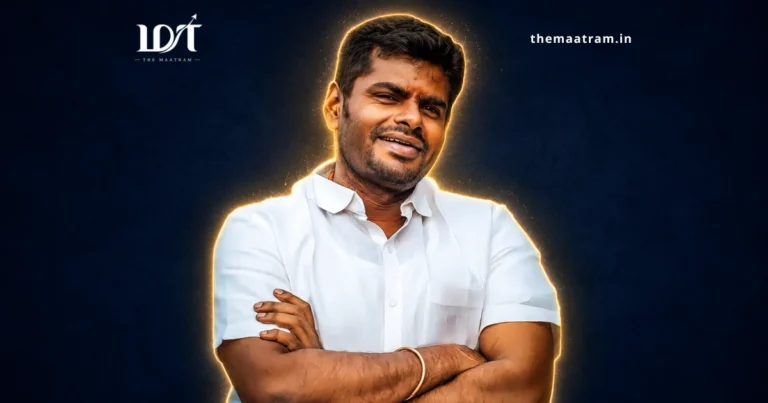
K. Annamalai joined the Bharatiya Janata Party in 2020 as a former IPS officer with no political pedigree, no caste coalition to lean on, and no inherited vote bank. Within ten months of joining, he was made the Tamil Nadu state unit chief — a meteoric rise by any measure. What followed was five years of relentless, aggressive politics that genuinely moved the needle for a party that had long been dismissed as a fringe player in Tamil Nadu.
Let us be clear about what he actually delivered.
The Numbers Don’t Lie
When Annamalai took charge, the BJP was pulling between 2 and 3 percent of the vote in Tamil Nadu — enough to win a handful of assembly seats in alliance but nowhere near enough to be taken seriously as an independent political force. He took the BJP flag to all 234 assembly constituencies through his ‘En Mann, En Makkal‘ yatra, building ground presence where none existed.
The electoral impact became visible over the next three years. In the 2024 Lok Sabha elections, BJP individually garnered 11 percent of votes — a number Annamalai himself described as “a major development.” With NDA alliance partners, the combined vote share touched 18 percent. For a party that could barely register a blip a few years prior, this was real, measurable growth.
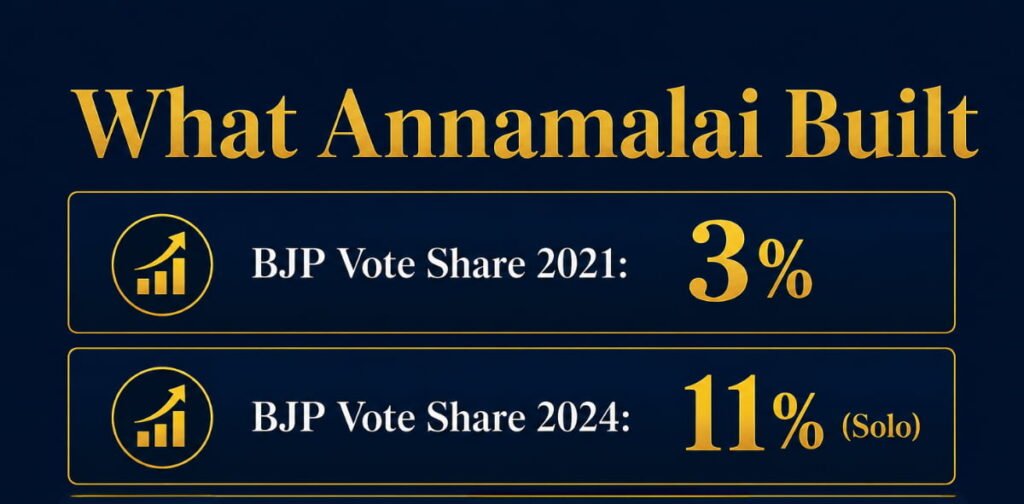
The BJP’s vote share in the 2021 Assembly elections was just 3 percent. From 3 percent to 11 percent in three years, entirely on the strength of one man’s ground work and combative political persona — that is not a small achievement. It is the kind of growth most state BJP units spend decades trying to build.
The Sacrifice Nobody Talks About
The relationship between Annamalai and the BJP leadership began fracturing not over ideology but over alliance arithmetic. Annamalai had opposed the alliance with the AIADMK and suggested that BJP should build independent organisational strength and contest more seats on its own symbol. He had also expressed dissatisfaction over the limited number of seats allotted to BJP by the AIADMK.
The 2026 Assembly results inevitably reopened the debate over whether Annamalai’s strategy of building the BJP independently might have produced a different long-term outcome. While no one can answer that question with certainty, the election outcome strengthened the arguments of those who had shared his concerns about the alliance.
The 2026 Assembly results proved that the BJP-AIADMK alliance did not deliver what the central leadership had hoped. The BJP’s strength in the Tamil Nadu Assembly dropped to just one MLA after the 2026 Assembly polls from the earlier four.
Yet here is the part that deserves more attention. Despite being publicly sidelined, despite being replaced as state president in April 2025 specifically to smoothen the alliance with a leader who openly disliked him, Annamalai still worked through the election cycle before formally informing the BJP on December 4, 2025 that he intended to resign. He did not storm out. He did not sabotage. He finished what he started, then walked away with his head held high.
Whatever one’s political opinion, his exit followed an orderly process rather than a public confrontation. He completed the election cycle before formally resigning—a detail often overlooked in today’s emotionally charged debates.
That is not the behaviour of a traitor to the party. That is the behaviour of a disciplined professional who recognised the point of no return.
None of this suggests that the BJP leadership acted without reason. National parties often make alliance decisions based on political calculations that extend beyond a single state. Many BJP workers genuinely believed that reviving the alliance with the AIADMK offered the most practical route to electoral growth in Tamil Nadu. That perspective deserves acknowledgment. However, recognising the leadership’s strategic choice should not come at the cost of erasing Annamalai’s contribution. He spent five years expanding the BJP’s visibility, building its grassroots presence, and taking the party into political spaces it had struggled to reach. Strategic disagreements are part of politics; reducing that entire journey to personal attacks does justice neither to the individual nor to the party.
A New Beginning, Not a Betrayal
On June 5, 2026, Annamalai formally resigned from the BJP and launched ‘We The Leaders‘, a people’s movement that he intends to evolve into a full-fledged political party to contest the 2031 Tamil Nadu Assembly elections. His resignation letter, addressed to BJP national president Nitin Nabin, emphasised his desire to bring positive change to Tamil Nadu and make politics accessible to the common man.
The We The Leaders movement is built on a ‘Conscious Constituency Approach’ that combines technology-driven governance with grassroots participation, focusing on education, health, sustainability, and youth leadership. The response from the public has been extraordinary — more than 13 lakh people enrolled in the movement within 24 hours of its launch. As of now, that number has crossed 18 lakhs and is still climbing. The movement’s hub is at wetheleader.org.
Annamalai has also launched a podcast series to directly communicate his vision to the public — unmediated, unfiltered, and in his own voice. Whatever one thinks of his politics, Annamalai has demonstrated an ability to build political organisation from the ground up. He first attempted it within the BJP and is now trying to do so independently.
A Word to the BJP Cadres Attacking Him
This is where The Maatram needs to say something plainly.
The spectacle on social media — particularly on X — of BJP functionaries and cadres attacking Annamalai, questioning his motives, calling him names, and waging what can only be described as a campaign of character assassination against a man who gave five productive years to the party — is both unedifying and strategically self-defeating.
BJP functionaries and RSS ideologues have already reacted strongly to Annamalai’s recent public remarks, exposing the widening rift in what was once a unified front.
Whether intended or not, the sustained public attacks risk shifting attention away from the BJP’s own organisational challenges after the 2026 election. Political parties rarely benefit when internal debates dominate more than their engagement with the government they seek to oppose.
Here is the strategic reality. Tamil Nadu now has a TVK government led by CM Vijay — fresh, historic, and carrying enormous public goodwill. The BJP’s job as an opposition force, however limited their assembly presence currently is, should be to scrutinise that government on governance, welfare delivery, law and order, and fiscal management. That is how you build credibility. That is how you grow from one MLA to something more consequential by 2031.
Spending political energy and social media bandwidth attacking Annamalai — a man who is now a private citizen building his own movement — is not opposition politics. It is noise. It signals insecurity, not strength. And Tamil Nadu’s electorate, which has proven itself to be one of the most politically sophisticated in the country, reads that signal clearly.
Wishing Him Well
The Maatram does not endorse any party or movement. But we believe in acknowledging effort honestly and calling out pettiness directly.
K. Annamalai built something real inside the BJP. He earned his departure with discipline and without bitterness. He is now attempting something ambitious — building a new political force in one of India’s most competitive political landscapes, with the 2031 elections as his stated target.
That deserves respect, not ridicule.
History will decide whether Annamalai’s next political experiment succeeds or fails. But history should also remember that before he walked out of the BJP, he spent five years trying to build it in Tamil Nadu. Political disagreements may explain why people part ways. They should never erase the work that came before.
Tamil Nadu’s political ecosystem is richer for having another serious, data-driven, ground-up player entering the arena independently.
To Annamalai — good luck.
To the BJP cadres — your time is better spent asking why you went from four MLAs to one, and what the answer to that question demands of you going forward.
The future is always built forward. Never backward.


One Comment