DMK’s Grand Alliance is Gone — And a New One is Rising Without Them
For several years, the Dravida Munnetra Kazhagam led one of Tamil Nadu’s most formidable political coalitions. The Secular Progressive Alliance — built patiently through the 2019 Lok Sabha elections, consolidated through the 2021 Assembly sweep, and stretched through the 2024 parliamentary polls — was the DMK’s, especially M.K.Stalin’s, single most powerful electoral asset. It swept all 39 Lok Sabha seats in 2024.
It gave the party alliance arithmetic that no opponent could match. It seemed, for a while, like an unbreakable political architecture.
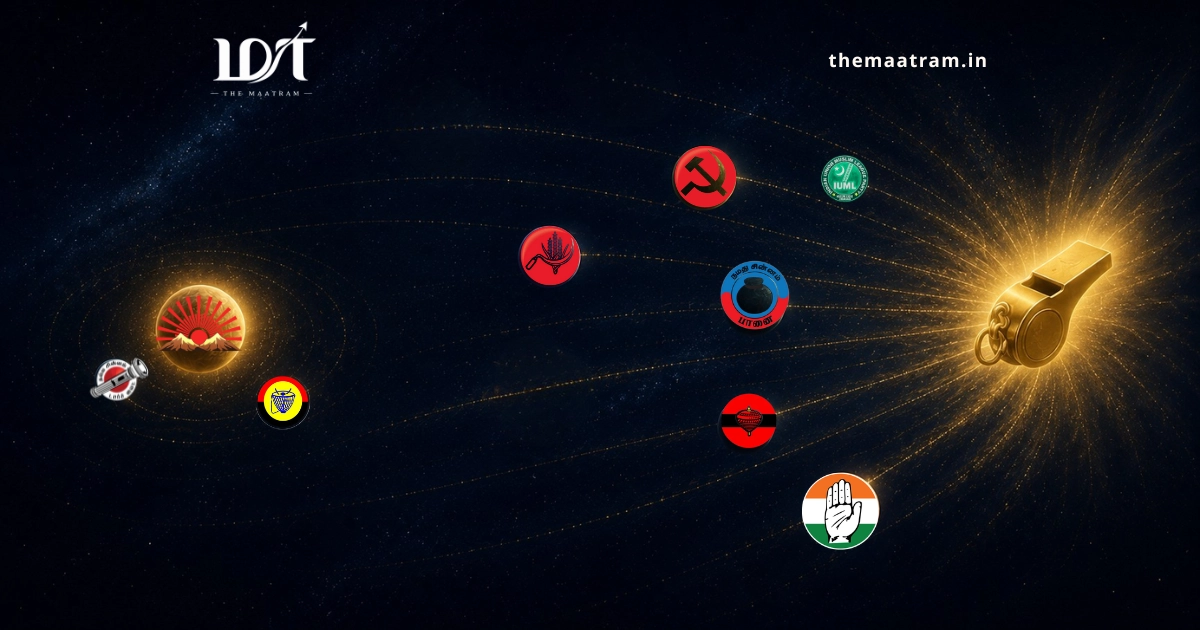
Today, that architecture lies in ruins. One by one, with quiet efficiency and devastating political logic, every significant partner has walked out. What remains of the SPA is a shadow of what it was. And what makes the situation truly unprecedented is this — the parties that left did not simply go home. They have gathered under a new roof. Tamil Nadu is now witnessing the formation of a rival alliance, led by CM Vijay’s TVK, that has absorbed almost every significant partner the DMK once called its own.
The Night the Alliance Began to Fall
The collapse began not gradually but suddenly — within hours of the May 4 election result.
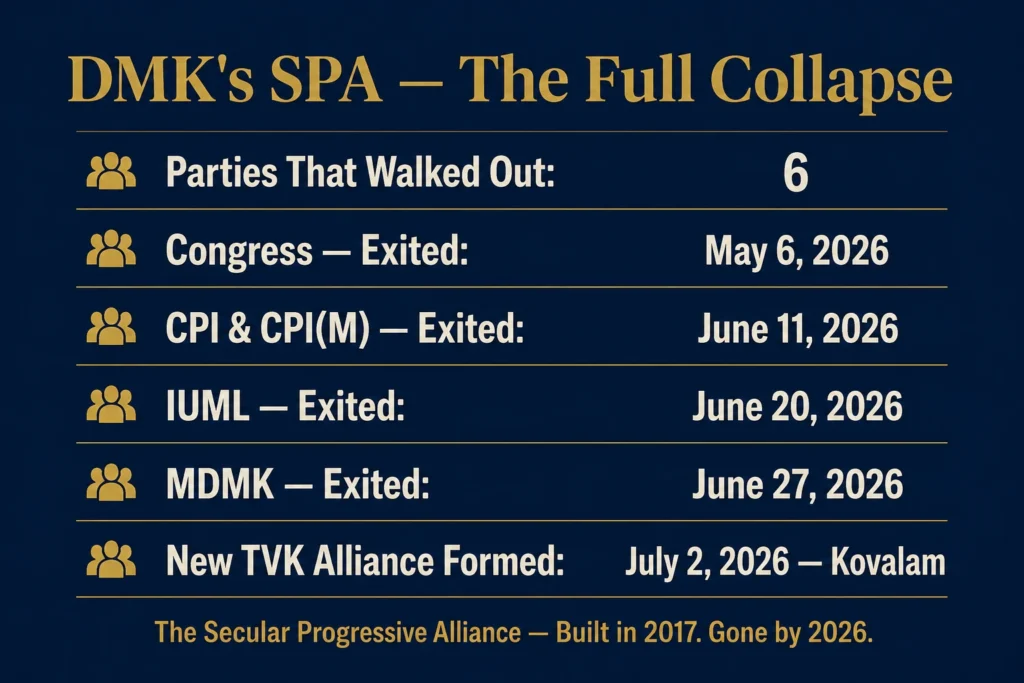
The Indian National Congress became the first to move. On May 6, the INC formally agreed to extend support to TVK, stating that the alliance would bring back the legacy of Kamaraj, the social justice ideals of Periyar, and the constitutional principles of Ambedkar in Tamil Nadu.
The DMK’s reaction was raw and immediate. DMK spokesperson Saravanan Annadurai called Congress “backstabbers,” labelling their decision myopic and saying they had gone against the mandate within just a day of results. The word “backstabbers” entered Tamil Nadu’s political lexicon that evening — and it has not left since.
The Left Follows — Formally and Finally
The Left parties initially attempted a careful balancing act — extending support to TVK on May 8 while insisting they remained within the DMK alliance. The pretence did not last. CPI(M) State Secretary Shanmugam stated clearly that after the party extended support to TVK on May 8, they never stated anywhere that they would continue in the DMK alliance.
On June 11, CPI State Secretary M. Veerapandian formally announced at a press conference in Coimbatore that it was no longer possible for the Communist Party of India to continue in the DMK alliance under the present circumstances — a decision taken after two days of internal consultations.
With both Left parties gone, the SPA had lost its ideological anchors.
IUML — The Alliance’s Last Major Formal Departure
On June 20, the IUML formally nominated sitting MLA A.M. Shahjahan for a cabinet position in the TVK-led government, signifying the party’s departure from the DMK-led Secular Progressive Alliance. The IUML had tried to maintain its DMK alliance membership even while its MLA sat in the TVK cabinet — a contradiction that became increasingly untenable. Soon after the results, the IUML had said it would remain with the DMK come what may. Political reality made that promise impossible to keep.
MDMK — Nine Years, Then Gone
The most emotionally charged departure came from Vaiko’s MDMK — a party that had been with the DMK-led SPA since December 2017, nearly nine years.
At its 32nd General Council meeting held in Chennai on June 27, the MDMK passed a strongly-worded resolution announcing its withdrawal from the Secular Progressive Alliance. The party said it had joined the alliance out of ideological commitment to prevent communal forces from gaining ground in Tamil Nadu and to uphold the principles of the Dravidian movement.
The MDMK alleged that after the election results were announced on May 4, it emerged that behind-the-scenes political deals had gone against the mandate given by the people — specifically, that arrangements were made to install an AIADMK government despite the party winning only 47 seats. The MDMK called this a betrayal of the alliance’s secular ideological foundation.
However, the MDMK’s exit comes with a significant complication. MDMK’s two MLAs — TM Rajendran from Kadayanallur and Senthil Selvan from Sirkazhi — had contested and won on DMK’s Rising Sun symbol. They would face disqualification if they formally switched allegiance. Rajendran publicly stayed away from the General Council meeting, stating he was not keen on resigning from his post.
The MDMK as a party has left the SPA. Its elected legislators, trapped by the anti-defection law, remain technically within the DMK legislative group — an awkward reality that neither side has resolved.
VCK — Still Straddling, But the Direction Is Clear
The VCK’s position remains the most carefully managed of all. VCK President Thol Thirumavalavan has maintained that the party extended support to TVK for government formation while retaining its formal alliance status with DMK.
On May 21, the VCK formally nominated sitting MLA Vanni Arasu for a cabinet position in the TVK-led government — making it a party with one foot in the TVK cabinet and one foot nominally in the DMK alliance. That position is not sustainable indefinitely, and the Kovalam meeting has since made the direction unmistakable.
The Kovalam Meeting — A New Alliance Takes Shape
The most consequential development in Tamil Nadu’s post-election political landscape happened not with a resignation letter but around a conference table at the Fisherman’s Cove resort in Kovalam on July 2, 2026.
A meeting of TVK and its friendly parties decided to convert their informal tie-up into a formal electoral alliance. The meeting was chaired by TVK president and Tamil Nadu Chief Minister C. Joseph Vijay and was attended by Tamil Nadu Congress Committee president and MP B. Manickam Tagore, senior Congress leader P. Chidambaram, VCK chief Thol Thirumavalavan, MDMK leader Vaiko, and IUML president K.M. Kader Mohideen.
The alliance meeting chalked out a three-stage framework — establishing a dedicated coordination committee, drafting a common minimum agenda, and finalising an official name for the coalition. Names under consideration include “Secular Social Justice Alliance” and “Tamil Nadu Progressive Social Justice Alliance” — though no final decision has been announced.
The Left parties — CPI and CPI(M) — did not attend the Kovalam meeting, stating that they are extending only outside support to the government and are not formally part of the ruling alliance. They separately met the Chief Minister earlier in the day to reiterate their support.
The proposed alliance’s immediate focus will be the upcoming Assembly bypolls in seven constituencies — Karur, Maduranthakam, Perundurai, Dharapuram, Ambasamudram, Viralimalai, and Tiruchirappalli East — which fell vacant after AIADMK legislator resignations and Vijay’s decision to retain the Perambur seat.
The strategic picture is now unmistakable. The DMK’s Secular Progressive Alliance, built over years, has been systematically dismantled and reassembled — under a different leader, with a different name, pointed in a different direction.
What Does DMK Have Left?
The DMK still has 59 MLAs — enough to be the principal opposition party. It has MK Stalin, a seasoned politician who lost his own seat at Kolathur but remains the party’s ideological and organisational core. It has decades of grassroots infrastructure, trade union networks, and a media presence that no other opposition party can match.
It also retains two minor allies who have not walked away — the DMDK and MNM. But their combined political weight is limited.
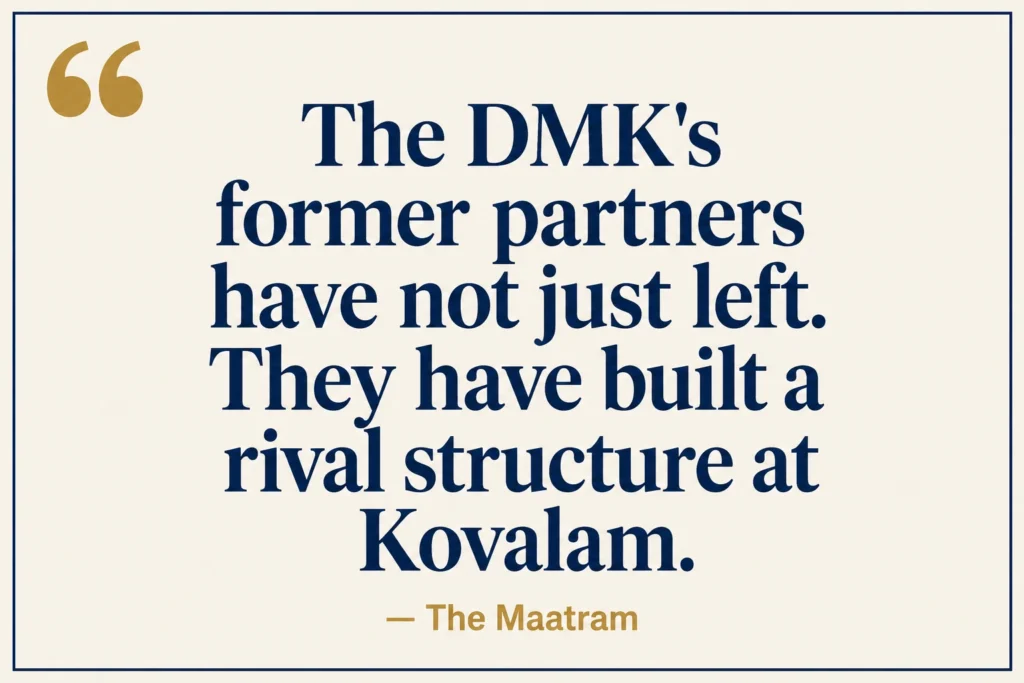
The brutal truth is this. The MDMK was the sixth party to walk out of the DMK-led SPA post the Assembly results in May. Congress, both Left parties, IUML, VCK, and now MDMK — every significant partner has gone. And they have not merely gone. They have formalised their new home at Kovalam, with a coordination committee, a common minimum agenda, and a name in the making.
The DMK that enters the 2029 Lok Sabha election and 2031 assembly election cycle will look nothing like the DMK that swept 159 seats in 2021 or won all 39 Lok Sabha seats in 2024. The mega alliance that made those victories possible no longer exists.
The Verdict
Tamil Nadu has seen political comebacks before. The DMK knows how to rebuild — it has done it after 1977, after 2001, after 2011. The party has institutional depth that most Tamil Nadu parties lack.
But there is something new and different about this situation that makes a simple comeback harder. In the past, when the DMK lost allies, those allies were either absorbed back eventually or remained in a state of political limbo. This time, the allies have not gone into limbo. They have gone to Kovalam — to sit around a table with CM Vijay and build something new together.
The DMK is not just losing partners. It is watching those partners actively construct the opposition to its own future ambitions.
The question for the DMK between now and 2031 is not whether it can win alone. The numbers suggest it cannot. The question is whether it can rebuild a credible alliance with parties that have already demonstrated they will leave the moment a better option appears — and whether those parties will even be available, having now formally committed to a rival front.
That is a harder problem than any election.
And right now, the DMK has no clear answer to it.

One Comment