Does Tamil Nadu Vote for Parties… or for Personalities?
Over the last few weeks, Tamil Nadu’s political conversations have been filled with emotion.
Some are disappointed. Some are angry. Some are hopeful. Some are celebrating. Social media has become a battlefield of opinions, especially after K. Annamalai’s decision to leave the BJP and continue his journey through the We The Leaders movement with plans to launch a new political party.
If we carefully observe the reactions, one thing becomes very clear.
For many supporters, this was not just about a leader changing his political path. It felt personal. The fear, the anger, the disappointment and even the excitement were all centred around one individual.
That emotional intensity points to a larger question — one that runs through the entire history of Tamil Nadu politics.
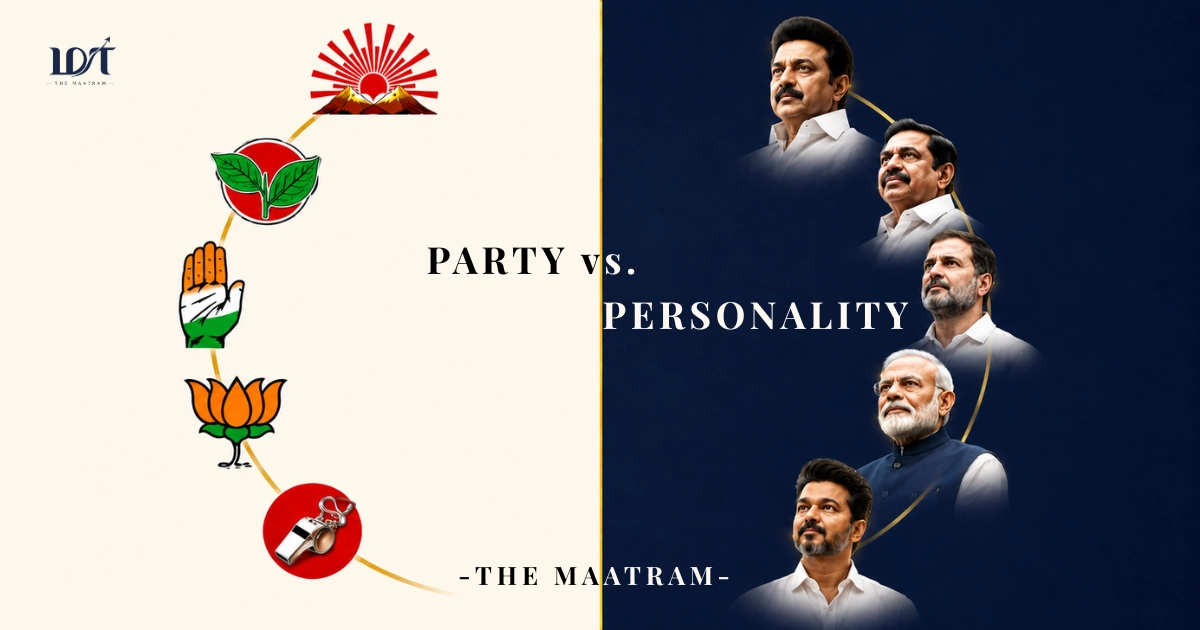
Does Tamil Nadu really vote for political parties… or does it vote for political personalities?
Before exploring that question, one clarification is worth making. The word cult is often misunderstood. Here it does not refer to blind worship or fanaticism — but to something more specific: a level of emotional connection where a leader becomes larger than the party itself. The leader becomes the identity of the movement.
Looking at Tamil Nadu’s political history, this pattern is impossible to ignore.
Think about the names that continue to dominate political conversations even today.
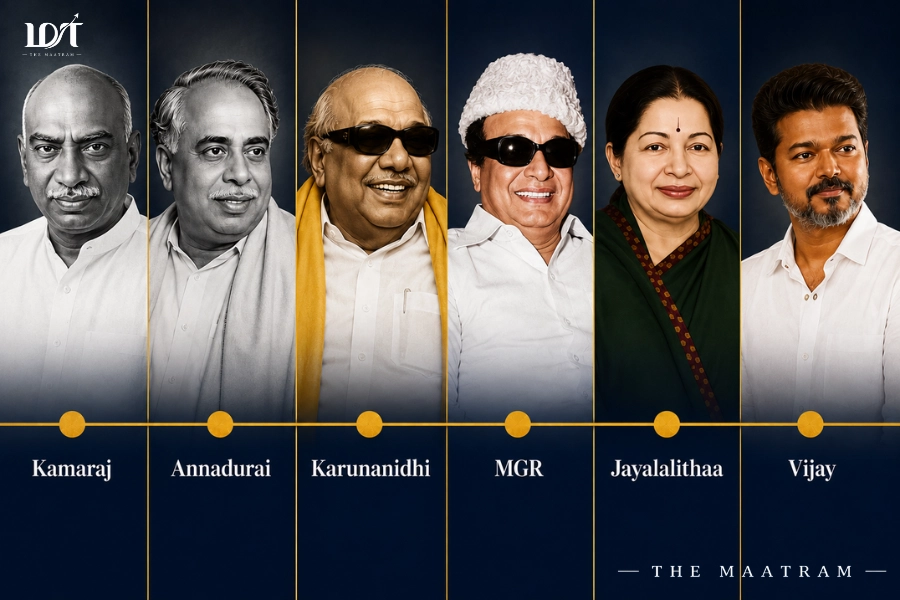
Kamaraj.
Annadurai.
Karunanidhi.
M.G. Ramachandran.
Jayalalithaa.
And now, Vijay.
Each belonged to a different political era. Each represented different ideologies, different styles of leadership and different generations of voters. Yet they all shared one common characteristic.
People remembered the leader before they remembered the party.
Even decades after Kamaraj’s time, political leaders continue to promise “Kamaraj Rule.” Nobody says they will bring back the old Congress organization. They invoke the personality.
The same happened with MGR.
Even today, many AIADMK supporters emotionally connect with “MGR Rule” more than they speak about the party as an institution.
After Jayalalithaa, the phrase “Amma Government” became more powerful than the party’s own name. Welfare schemes carried her identity. Supporters proudly identified themselves with Amma before identifying themselves with the organization.
Karunanidhi was not merely the leader of the DMK. For millions, he was the face of the movement. His speeches, writings and political presence became inseparable from the party itself.
This is not unique to one ideology or one political party. It is a recurring pattern in Tamil Nadu politics.
Many political analysts often describe Tamil Nadu as a highly emotional political state. Voters certainly evaluate governance, welfare, caste equations, local candidates and alliances. But alongside all these factors, leadership has always occupied a special place in public imagination.
People do not merely elect governments. They often place their trust in a person.
The recent Assembly election offered another interesting example.
Vijay entered active electoral politics only a short time before the election. Compared to established parties, his campaign was remarkably limited. He held relatively few public meetings, stayed away from frequent television debates, had no engagement with the mainstream media and faced restrictions after the Karur incident. A large majority of his candidates were newcomers to politics. His party contested almost the entire state without the support of a major alliance.
Yet the election results demonstrated that he had built significant public support within a very short period.
Whether one agrees with his politics or not is a separate discussion.
The more interesting question is this:
Would the same result have been possible without Vijay himself?
Most people would probably say no.
His personal popularity became the engine that carried an entirely new political organization.
That is the power of a political personality. Interestingly, this is not unique to Tamil Nadu. Across India, we often remember governments through their leaders.
We speak of Nehru’s India.
Indira Gandhi’s government.
Vajpayee’s leadership.
The Modi government.
Very rarely do ordinary citizens describe political history by simply referring to party names or election years. Leaders become the reference point through which people remember political eras.
Today’s BJP provides another example worth thinking about.
There is no doubt that the BJP is a much older and stronger organization than any one individual. It has an ideological framework, an organizational structure and thousands of leaders across the country.
Yet it is equally true that in large parts of India, Narendra Modi has become the face of the BJP.
In many northern, western and eastern states, elections are often fought with Modi at the centre of the campaign. Local leaders certainly matter, but they frequently operate under the larger political identity created by Modi’s leadership.
This is not a criticism. Neither is it praise.
It is simply an observation of how modern electoral politics increasingly functions. Leadership has become the most powerful political brand. In Tamil Nadu, that truth has been tested and proven across every political generation.
Coming back to Tamil Nadu, the emotional reactions surrounding Annamalai’s exit from the BJP reveal something similar.
Supporters are not merely discussing organizational changes.
They are discussing the future of a leader in whom they invested enormous hope.
For many BJP workers in Tamil Nadu, Annamalai represented more than a State President.
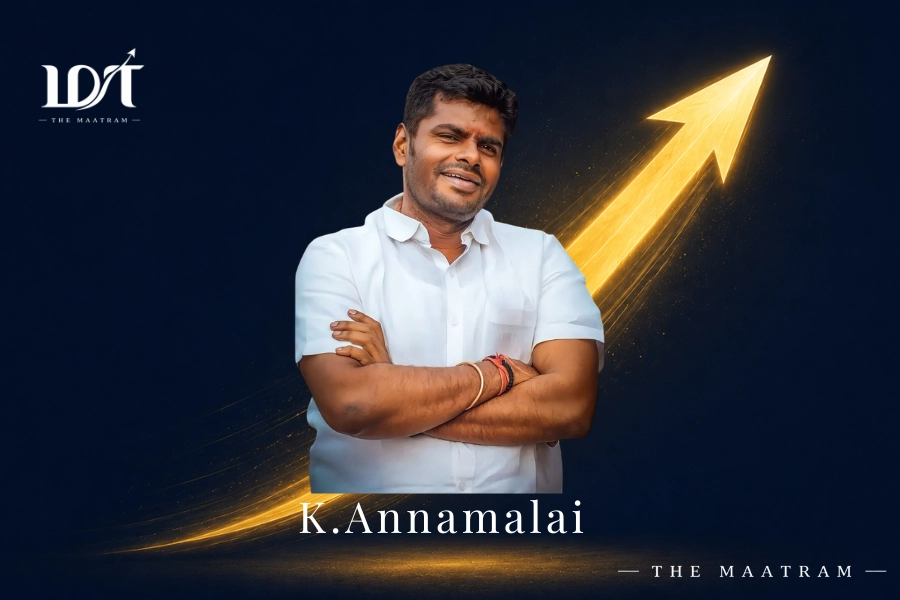
He represented the possibility of changing the political landscape of the state. Whether one agrees with that belief or not is irrelevant. The emotional response itself tells an important story.
People respond emotionally to personalities. Much more than they respond to organizational restructuring.
But this raises an even bigger question.
If charismatic personalities are necessary to build political movements, can those movements eventually become stronger than the personalities themselves?
History offers mixed answers.
Every successful political movement usually begins with one extraordinary leader.
Very few survive without building strong institutions.
A leader can inspire people. A leader can attract volunteers. A leader can win elections.
But institutions are what sustain movements across generations.
Perhaps that is the real challenge before every emerging political force in Tamil Nadu.
Not just for Annamalai.
Not just for Vijay.
But for anyone who wishes to reshape the state’s political future.
Can they build a movement where people initially come because of the leader, but eventually stay because of the values, the organization and the vision?
That transformation is far more difficult than winning an election.
As Tamil Nadu slowly moves towards 2031, several new political equations will emerge. Alliances will change. Strategies will change. Campaign methods will evolve. Artificial Intelligence, digital media and grassroots mobilization will play even bigger roles.
But one question may continue to dominate all political calculations.
Will Tamil Nadu once again choose its next government through the power of one extraordinary personality?
Or will the state witness something it has rarely seen in its modern political history—a political institution becoming more powerful than the individual leading it?
Only time will answer that question.
Until then, perhaps the more appropriate question is not whether Tamil Nadu votes for parties or personalities.
Perhaps it has always voted for both.
The difference is that while parties contest elections, it is often personalities that capture the imagination of the people.
And in a democracy, imagination is sometimes the most powerful campaign of all.